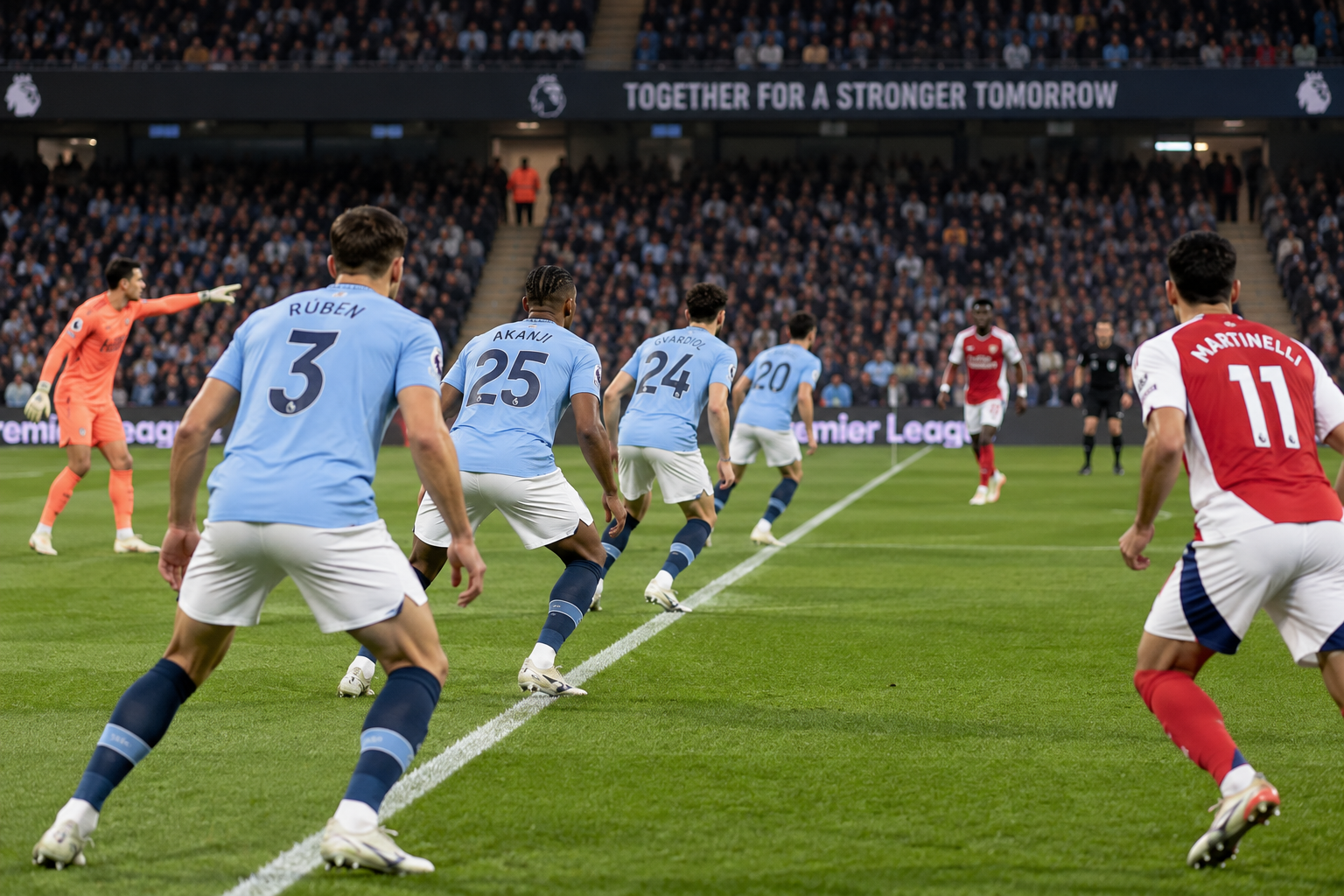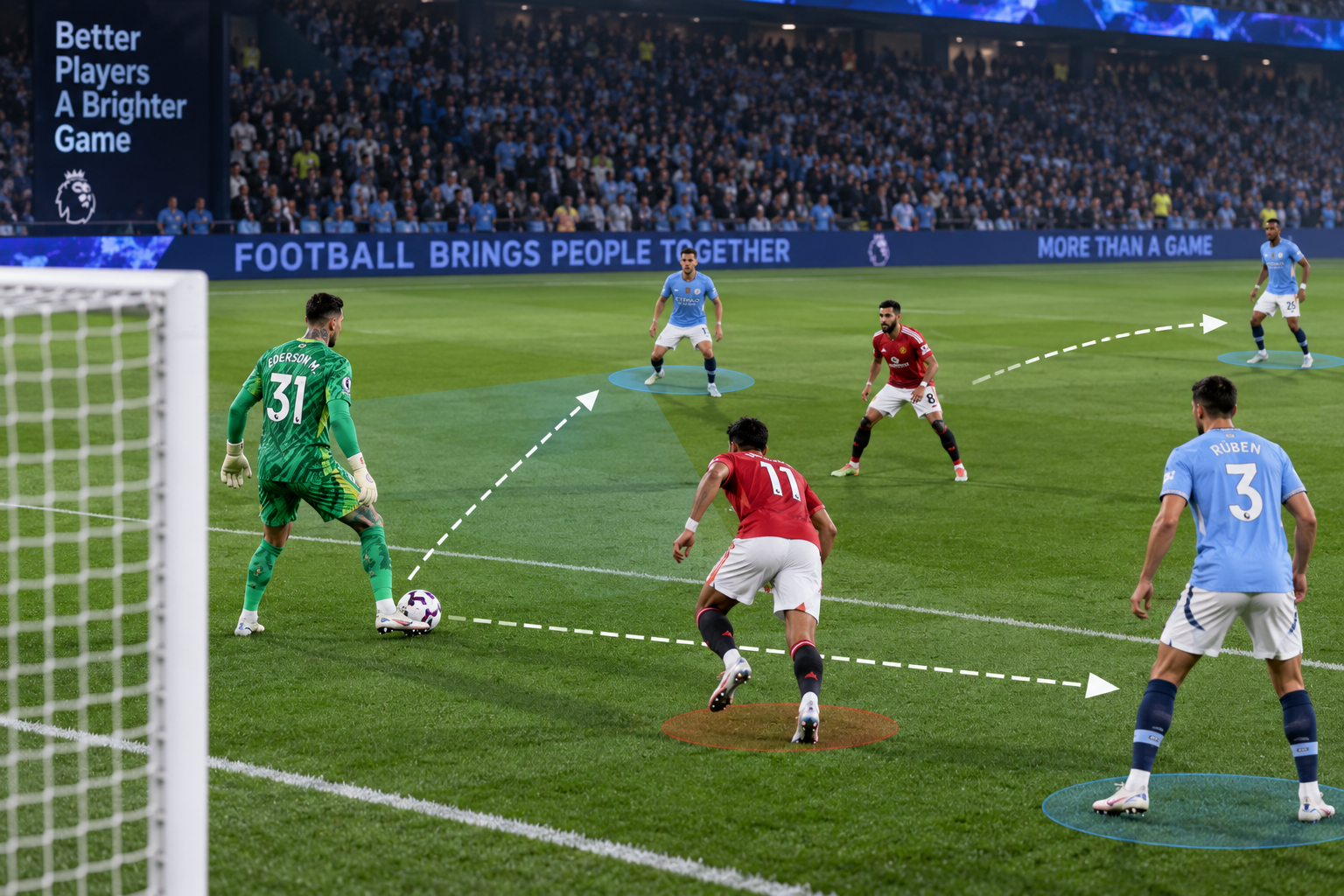
A goalkeeper receives the ball inside the penalty area.
A striker is already running toward him. Two defenders split wide, a midfielder drops closer, and instead of sending the ball as far away from goal as possible, the goalkeeper calmly passes it five yards.
For supporters watching from the stands or at home, the situation can feel unnecessarily dangerous.
Why take that risk?
Yet playing out from the back has become an important part of modern football because the objective is not simply to keep possession near your own goal. Teams are trying to manipulate the opposition, escape pressure, and create better attacking situations further up the pitch.
Playing Out From the Back Is About Progression
The phrase can create the wrong impression.
Playing out from the back does not mean a team wants its defenders to exchange short passes forever. The objective is eventually to move the ball into more dangerous areas while maintaining enough control to choose how that progression happens.
Instead of immediately kicking long and contesting a loose ball, a team may attempt to construct an attack through its goalkeeper, defenders, and midfielders.
The short passes are the beginning of the attack, not the final objective.
The Goalkeeper Changes the Numbers
One of the biggest tactical advantages begins with the goalkeeper.
When a team has possession, the goalkeeper can effectively become an additional outfield passing option.
Imagine two opposing forwards pressing two center-backs. If the goalkeeper participates, the team in possession can create a three-versus-two situation in the first line.
Now one player should theoretically be available.
The opposition can send another player forward to eliminate that advantage, but doing so requires someone to leave another area of the pitch.
This is where build-up becomes a game of numbers.
Pressing Creates Space Somewhere Else
A pressing team cannot put eleven players everywhere simultaneously.
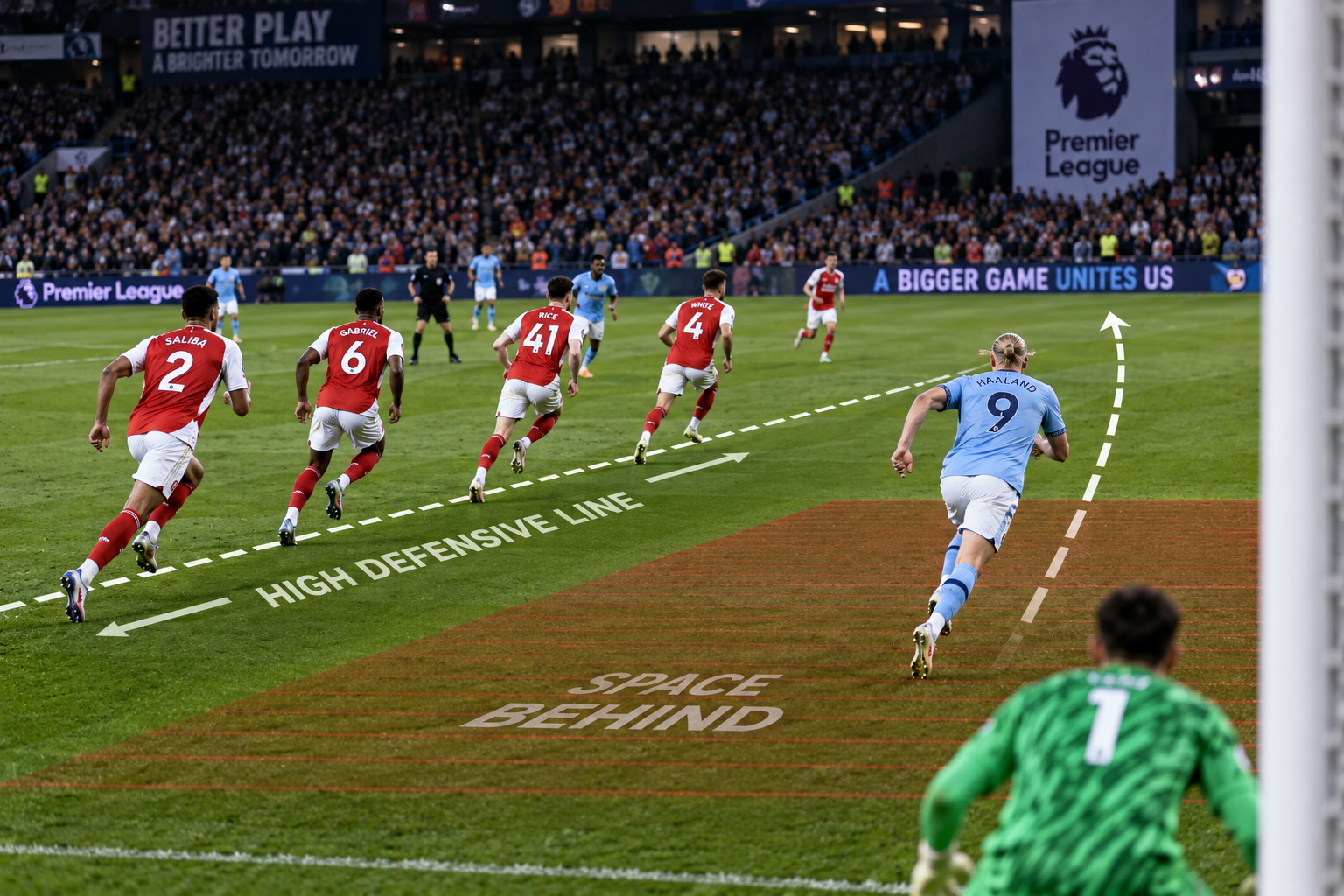
If several opponents move forward aggressively to pressure the goalkeeper and defenders, they leave space behind them.
The team building from the back wants to exploit exactly that.
A successful sequence may involve only three or four short passes, but those passes can encourage the opposition to move toward the ball.
Once enough defenders have been drawn forward, a pass through or over the press can suddenly release a midfielder or attacker into much more open space.
The apparent danger near one goal is being used to create an advantage toward the other.
This Is Why Teams Sometimes Invite Pressure
It can look strange when a defender has space but does not immediately carry the ball forward.
Sometimes the team actually wants the opponent to approach.
If nobody presses, there is little reason for the opposition’s shape to open.
By holding the ball for another moment, a center-back or goalkeeper may encourage an attacker to leave their position and commit to the press.
That movement changes the geometry of the pitch.
The next pass is then designed to exploit the space the pressing player just abandoned.
The Free Player Is the Key
Much of build-up football revolves around finding a player who is temporarily unmarked.
That player may be a center-back, full-back, midfielder, or even the goalkeeper.
The identity matters less than the numerical relationship.
Suppose three opponents press four players involved in the first phase of build-up. Somewhere within that structure, the team in possession should have an extra player.
The challenge is finding that player before the opposition adjusts.
Once the free player receives facing forward, the entire attack can accelerate.
Midfielders Do Not Always Stand in Midfield
During build-up, a midfielder may drop between the center-backs or move beside them.
Another may position behind the opposition’s first line of pressure.
These movements can create difficult decisions for defenders.
Should an opposing midfielder follow the player who drops deeper?
If they do, space may open behind them.
If they stay in position, the deeper midfielder may receive freely and help create an overload near the ball.
The movement itself can therefore be valuable even before the player receives a pass.
Full-Back Positioning Changes the Shape
Full-backs can take several different positions during build-up.
One may stay wide near the touchline.
Another might move higher.
Some tactical systems bring a full-back into central areas, although that becomes part of the inverted full-back concept we have discussed separately.
What matters here is that width changes the distances the opposition must defend.
If defenders spread across the pitch, pressing them requires opponents to cover larger spaces.
That can create passing lanes through the middle.
Center-Backs Need More Than Defensive Ability
Modern center-backs are frequently asked to participate directly in attacking construction.
That requires receiving under pressure, recognizing passing lanes, controlling the ball with an appropriate first touch, and deciding when to pass versus carry forward.
A center-back who steps into open space can force an opponent to react.
If nobody closes him down, he can continue advancing.
If someone leaves midfield to press him, a teammate may become free.
Ball carrying therefore becomes another way of manipulating defensive structure.
Body Position Matters Before the Pass Arrives
A player can receive the correct pass and still lose the advantage through poor body orientation.
If a midfielder receives with their back completely toward the attacking direction, they may need several touches before progressing.
That gives the press time to recover.
Players therefore often scan before receiving and position their bodies so they can see multiple options.
A small technical detail can determine whether a pass successfully breaks pressure or simply sends the ball back where it came from.
Passing Through the Press Changes the Attack
Not every successful build-up needs ten passes.
Sometimes one vertical pass changes everything.
If the ball travels from a center-back directly into a midfielder positioned behind the first pressing line, several opponents can effectively be removed from the immediate defensive action.
The midfielder can then turn, combine with another player, or move the ball forward.
This is one reason vertical passing lanes are so valuable.
The goal is not accumulating passes.
It is eliminating defenders from the phase of play.
A Third-Man Combination Can Beat Tight Pressure
Sometimes the obvious receiver cannot safely turn.
That does not make the pass useless.
A team can use a third-player combination.
Player A passes to Player B. The opposition reacts to B, who quickly lays the ball toward Player C moving into the newly available space.
The ball reaches C even though a direct pass from A to C may originally have been blocked.
These combinations allow teams to progress through areas where individual players have very little time on the ball.
Width Can Stretch the Press
A narrow pressing structure can protect central areas effectively.
Wide positioning forces a choice.
Does the opposition continue protecting the middle and allow a defender or full-back more space outside?
Or does someone move wide to press?
If they move outward, a central passing lane may appear.
This constant exchange of space is why build-up formations can look unusually wide when the goalkeeper has possession.
The team is trying to make the defending shape cover as much territory as possible.
Going Long Is Not Always Abandoning the Plan
This is an important distinction.
Playing out from the back does not require every goal kick to become a sequence of short passes.
Sometimes the opposition commits so many players forward that a long pass becomes the correct solution.
If six opponents move toward the defending team’s half, fewer players remain behind them.
The goalkeeper may then send the ball directly toward a forward, winger, or open space.
The earlier short positioning helped create that opportunity by attracting the press.
In that situation, the long ball is not necessarily a panic clearance. It can be the final move of the build-up strategy.
The Difference Is Whether the Long Ball Has a Target
A desperate clearance and a planned direct pass can look similar from a distance.
Their intentions are different.
A clearance primarily removes immediate danger.
A planned long pass attempts to reach a specific player, zone, or matchup while teammates are positioned to compete for the first or second ball.
This distinction matters when analyzing teams that mix short and direct build-up.
A team can value controlled possession without insisting on short passes in every situation.
Why Not Just Kick Long Every Time?
Because a long ball often creates a contest rather than controlled possession.
The receiving forward may need to win an aerial duel. Even if they do, the second ball can still fall to either team.
That does not make direct football ineffective.
It simply changes the type of situation being created.
A team confident in its aerial strength or second-ball structure may deliberately prefer that approach.
Another team may prefer using shorter combinations because its technical qualities provide a better chance of retaining control.
Football tactics depend heavily on personnel.
Mistakes Look Worse Near Your Own Goal
There is an obvious downside to playing out from the back.
Losing possession twenty meters from the opposition goal is very different from losing it twenty meters from your own.
The opponent may need only one pass or shot to create a major chance.
This is why build-up errors attract so much attention.
A misplaced pass near the penalty area can immediately become a goal highlight, while dozens of successful build-up sequences during the same match may receive far less attention.
The risk is real, even when the strategy itself is rational.
Pressing Teams Try to Create Those Mistakes
Opponents understand the danger too.
They may deliberately show the goalkeeper or defender one apparently safe passing option.
As soon as the pass is played, several players move.
This is a pressing trap.
The objective is to guide possession toward an area where the receiving player has limited options, then attack aggressively.
That means build-up is not simply a technical exercise.
It is a tactical contest between one team trying to create a free player and another trying to make that free player an illusion.
A Pressing Trigger Can Change Everything
Pressing teams often wait for specific moments before accelerating.
A poor first touch may be one trigger.
A backward pass can be another.
A pass toward the touchline may also encourage pressure because the receiving player has fewer directions available.
The team in possession needs to recognize these moments.
A passing option that looked safe two seconds earlier can become dangerous once the opposition begins moving as a unit.
Technical Quality Sets the Limit
A tactical plan only works if players can execute it.
A goalkeeper may understand where the pass should go but still need the technique to deliver it accurately under pressure.
A midfielder may occupy the perfect position but lose possession if the first touch is poor.
This is why managers adapt build-up structures to their squad.
Trying to copy another team’s system without players suited to its technical demands can create risk without producing the intended advantages.
Decision-Making Matters More Than Ideology
There are moments to play short.
There are moments to carry the ball.
There are moments to switch play.
And there are moments when the best option is simply to send the ball beyond the press.
Strong build-up teams are not necessarily the teams that refuse to kick long.
They are often the teams capable of recognizing which solution the opposition is offering.
Predictability makes pressing easier.
Multiple credible solutions make it harder.
Watch the Opposition, Not Just the Ball
When watching a Premier League match, it is easy to follow the ball exclusively.
Try watching the pressing team instead.
Count how many players move toward the goalkeeper and defenders.
Then look behind them.
Which midfielder has been left alone? Has a winger moved inside? Is a full-back free near the touchline? Is a forward isolated against one defender further upfield?
Suddenly, a five-yard pass between defenders starts making more sense.
The important action may actually be happening thirty meters away from the ball.
The Best Build-Up Can Look Almost Too Easy
When the structure works perfectly, the result can seem surprisingly simple.
Goalkeeper to center-back.
Center-back to midfielder.
Midfielder turns.
Suddenly the team is attacking four defenders with several players running forward.
The spectacular part is often the final attack, but the advantage may have been created much earlier when the team encouraged opponents to press.
That is the central logic of playing from the back.
The team accepts controlled pressure in one area to create usable space somewhere else.
Conclusion
Playing out from the back is not about making as many short passes as possible near your own penalty area.
It is a method of progressing the ball while manipulating the opposition’s defensive structure.
The goalkeeper can create a numerical advantage. Defenders spread the pitch. Midfielders move between pressing lines. Short passes encourage opponents to commit forward, and the team searches for the free player that appears as a result.
Sometimes the solution is a short vertical pass.
Sometimes it is a third-man combination.
And sometimes, after drawing six opponents toward your own goal, the smartest pass is a long one over all of them.
That is why the next time a goalkeeper calmly waits with an attacker sprinting toward him, the important question is not simply, “Why doesn’t he clear it?”
Look behind the attacker.
The space the team wants may already be opening.