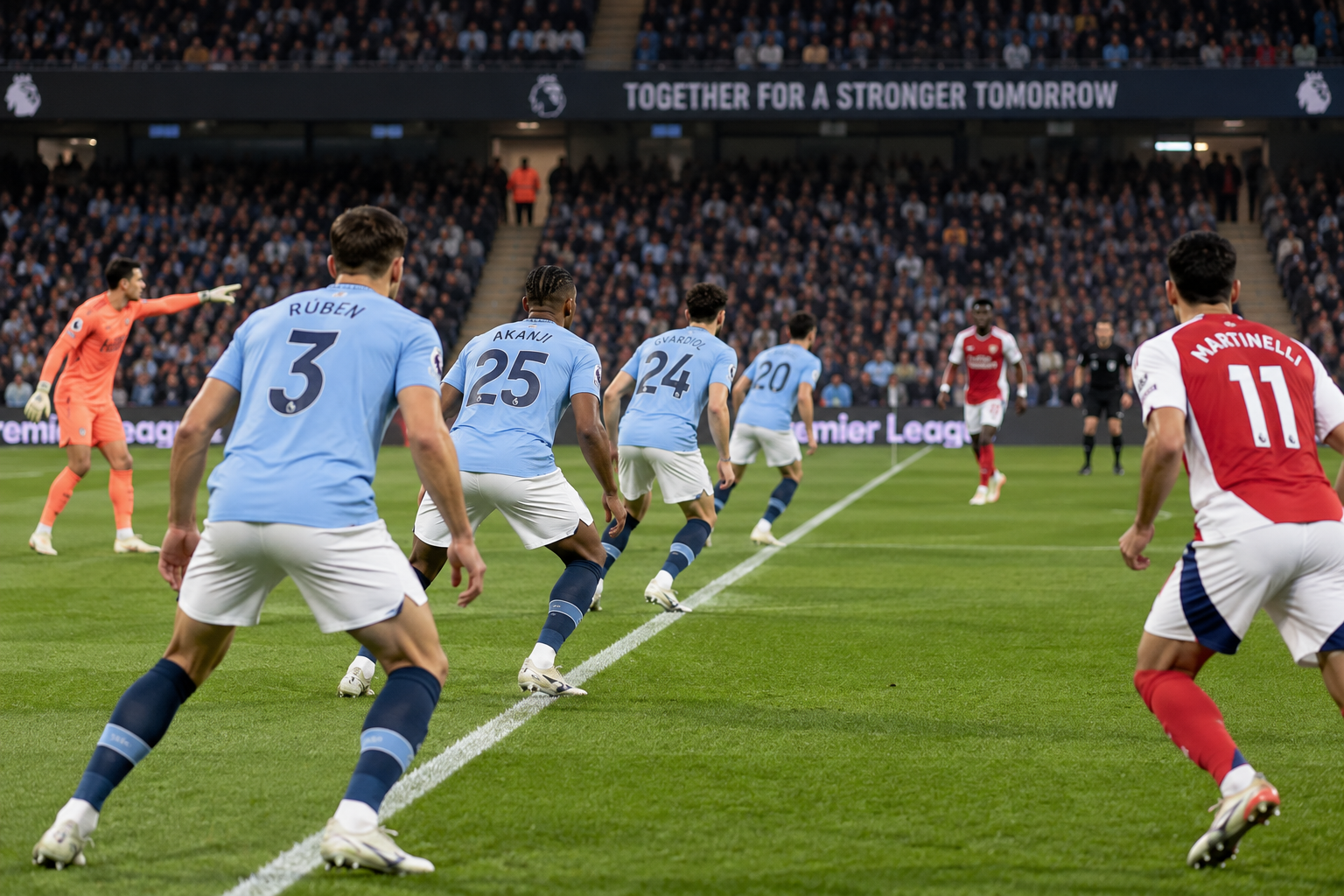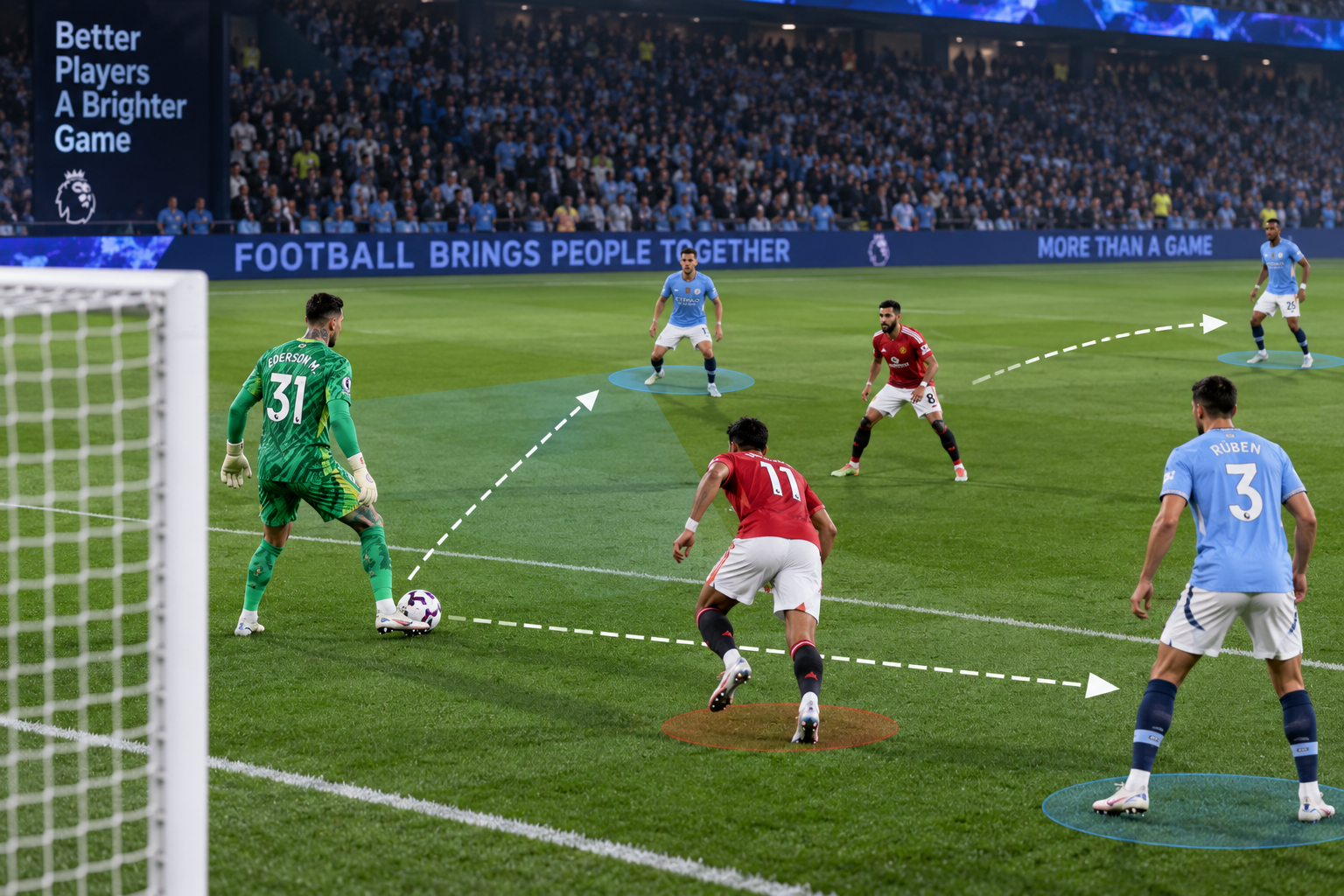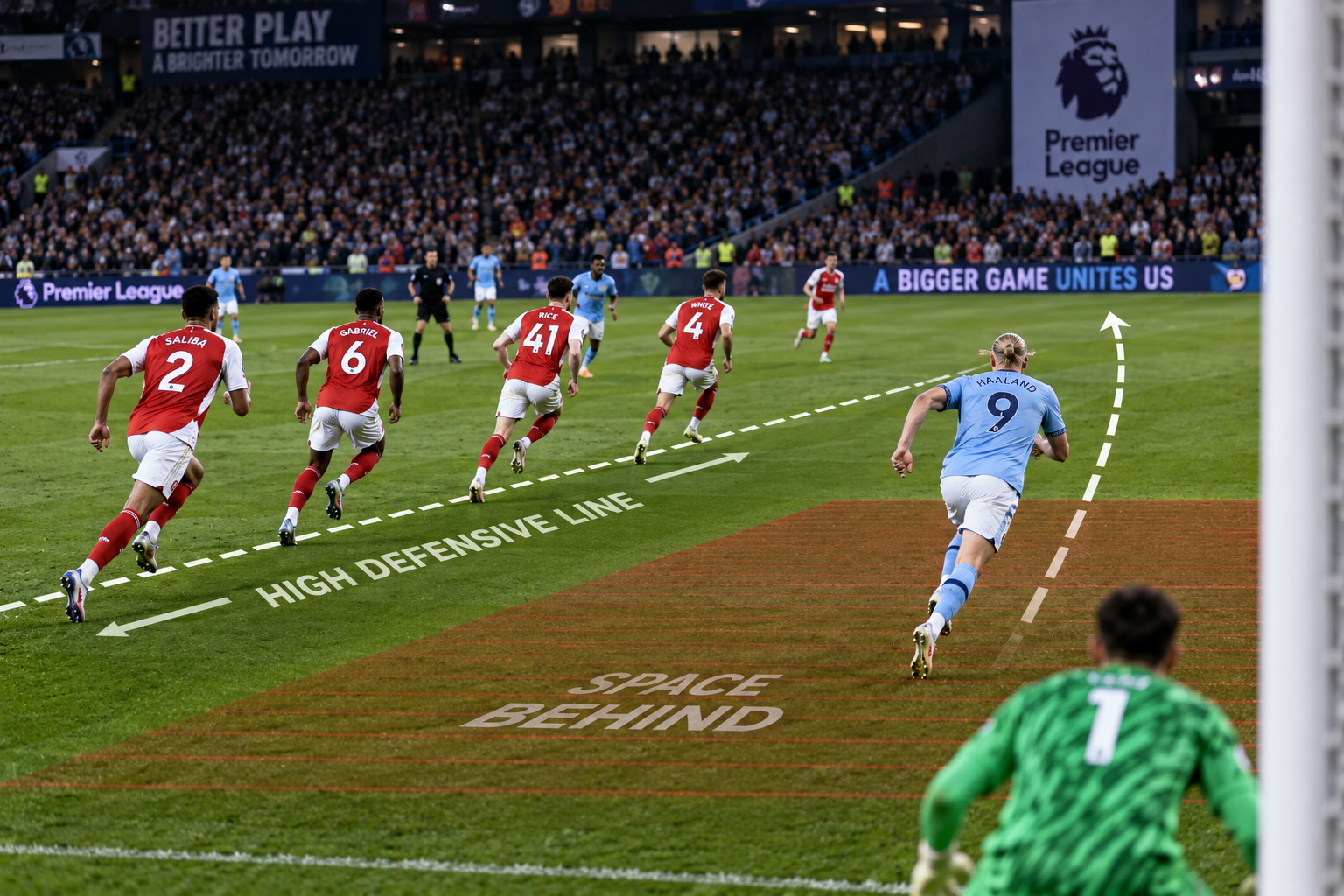
Watch an aggressive Premier League team when it has possession in the opposition half and something can look immediately dangerous.
The center-backs may be standing close to the halfway line. The full defensive unit is pushed forward, while a huge amount of grass appears completely unprotected behind them.
One accurate through ball seems capable of causing disaster.
So why would a team deliberately defend like this?
Understanding how a high defensive line works means looking beyond the defenders themselves. The system is designed to compress the pitch, support pressing, keep teammates close together, and make it difficult for opponents to build attacks comfortably.
The empty space behind the defense is real.
The tactical idea is to make reaching that space extremely difficult.
A High Line Makes the Usable Pitch Smaller
Imagine a team pressing near the opponent’s penalty area while its defenders remain 30 or 40 meters behind the midfield.
Huge spaces appear between the lines.
An opponent who escapes the first press can receive the ball with time, turn, and attack the defense directly.
Moving the defensive line forward changes that geometry.
The defenders, midfielders, and forwards become much closer together. The team can occupy a relatively compact vertical area instead of stretching across most of the pitch.
That compactness is one of the main reasons teams defend high.
Pressing Needs Players Behind the Press
A forward sprinting toward a center-back is not automatically an effective press.
If the midfield stays far behind, the defender can simply pass through the first line.
The pressing player has worked hard without actually reducing the opponent’s options.
A coordinated high press requires the rest of the team to move with it.
As the forwards advance, midfielders push higher to close nearby passing lanes. The defensive line then moves forward behind the midfield.
The entire block travels together.
Without that collective movement, pressing becomes a series of isolated sprints.
The Defenders Are Protecting Space in Front of Them Too
Defenders are often imagined primarily as players protecting the area behind them.
In a high line, they also help control what happens ahead.
When an opponent attempts to play into a forward dropping between midfield and defense, an aggressive center-back may be close enough to challenge immediately.
If the defensive line were much deeper, that forward could receive the ball in a larger pocket.
By stepping higher, defenders reduce the room available between the lines.
The risk behind them increases, but the space in front becomes easier to contest.
The Offside Rule Becomes Part of the Defensive Structure
A high defensive line naturally places attackers closer to the offside boundary.
That can restrict when and where opponents make forward runs.
If a striker leaves too early, the pass may become unusable because the attacker is offside when the ball is played.
This allows defenders to control space without physically occupying every yard behind them.
But an offside line only works when defenders coordinate.
One defender standing several meters deeper can keep an attacker onside and undermine the positioning of the entire unit.
Why Defenders Keep Stepping Forward
You may notice a defensive line moving forward immediately after an opponent passes backward.
That movement is often deliberate.
A backward pass reduces the immediate threat of a ball behind the defense. The defending team can use that moment to squeeze the pitch again.
The back line steps up.
Midfield follows.
Forwards can press again with teammates closer behind them.
These small collective movements repeatedly reshape the amount of space available to the opponent.
A high line is therefore not a fixed position on the pitch.
It constantly moves according to the ball and the situation.
The Ball Carrier Changes Everything
Not every opponent should be defended with exactly the same line.
If the player on the ball is facing their own goal under pressure, playing an accurate long pass behind the defense is difficult.
The defending team may feel comfortable stepping higher.
But if a technically strong midfielder receives the ball facing forward with time and no pressure, the situation changes immediately.
Now the player can see runs developing and has the time required to execute a pass.
A high line becomes significantly more vulnerable when there is no pressure on the ball.
That is why pressing and defensive depth cannot really be separated.
Pressure on the Pass Is Crucial
Suppose a striker is extremely fast.
That alone does not guarantee they can exploit a high line.
Someone still has to deliver the pass.
If the passer is being pressed aggressively, their body position, vision, and passing accuracy may all be restricted. A defender does not necessarily need to win the ball immediately if the pressure forces a rushed or predictable pass.
Remove that pressure and the same defensive position becomes much more dangerous.
An opponent with time can measure the run, wait for the correct moment, and choose exactly where to place the ball.
Fast Attackers Still Create a Serious Threat
A high line does not magically remove the danger of pace.
A quick forward making well-timed runs can attack the space behind aggressively, particularly when a midfielder has enough time to find them.
This can force defenders into repeated recovery runs toward their own goal.
Teams therefore need more than an offside strategy.
Center-backs must read danger early, react quickly when the line is broken, and defend large spaces without the protection of a deep block.
Athletic ability matters, but anticipation and positioning are equally important.
The Goalkeeper Becomes Part of the Space Behind
When defenders move higher, the goalkeeper’s role changes.
A goalkeeper who remains extremely close to the goal line can leave an enormous uncontrolled area between themselves and the defense.
Many teams using aggressive defensive lines therefore rely on the goalkeeper to position higher when appropriate.
This allows the goalkeeper to intercept some through balls before an attacker reaches them.
The role is often associated with the term sweeper-keeper.
It requires judgment.
Come too late and the attacker may arrive first. Move too aggressively and the goalkeeper can create a different kind of risk.
Long Balls Are Not Automatically a Solution
From the stands, beating a high line can look simple:
Just kick the ball over it.
But a hopeful long ball and a controlled pass into space are very different.
If the pass is inaccurate, the goalkeeper may collect it. A center-back may recover comfortably, or the ball may simply run out of play.
The attack also needs a runner who anticipates the pass correctly.
Effective exploitation of a high line depends on timing, passing quality, positioning, and the situation of the ball carrier.
That is why teams can leave visible space behind without conceding from every long pass.
One Defender Can Break the Entire Line
The defensive line works collectively.
Suppose three defenders step forward while the fourth reacts half a second late.
An attacker who would otherwise be offside may suddenly remain legal.
This is why high-line defending demands constant communication and awareness.
Defenders must understand the position of teammates even while watching the ball and tracking attackers.
The mistake can be extremely small.
At Premier League speed, however, a small positional difference can create a clear chance within seconds.
The Weak-Side Defender Still Matters
Danger does not always develop near the ball.
Imagine an attack building on the right side of the pitch.
The left-sided defender may appear far away from the action, but their positioning still influences the defensive line.
If that player drops unnecessarily deep, an attacker elsewhere may remain onside.
If they push too aggressively without reading the situation, space can open behind them.
High-line defending requires the entire back unit to react to the same picture, including players who are not directly involved in the immediate duel.
High Lines Can Help Teams Win Second Balls
An opponent under pressure clears the ball long.
If the defending team’s center-backs are already positioned high, they can challenge for the clearance closer to midfield.
The surrounding midfielders are also nearby because the team is compact.
Even if the first header does not produce clean possession, the team may be well positioned to contest the second ball.
This can keep the opponent trapped in its own half.
Instead of every clearance resetting the attack, possession pressure continues.
That territorial advantage is a major reason aggressive teams are willing to accept the risk behind them.
It Can Keep Attacking Players Closer to Goal
Defensive positioning influences attacking positioning too.
If a team’s back line stays very deep while it attacks, the midfield may also need to remain more conservative to maintain connections.
That can leave forwards isolated.
Push the entire team higher and more players can operate near the opposition penalty area.
Loose balls can be recovered more quickly.
Counter-pressing becomes easier because several teammates are already close to the point where possession was lost.
The high defensive line therefore supports the attacking structure as much as the defensive one.
Losing the Ball Is the Dangerous Moment
A team can look completely dominant while circulating possession around the opposition box.
Then one pass is intercepted.
Suddenly the opponent has the ball and dozens of meters of space behind the defensive line.
This transition is one of the critical tests of an aggressive structure.
The team that lost possession may immediately counter-press to prevent the first forward pass.
Meanwhile, defenders evaluate whether to hold the line, step toward a receiver, track a runner, or begin dropping.
The first few seconds after possession changes can determine whether the high line remains an advantage or becomes a vulnerability.
Counter-Pressing Protects the High Line
This explains why high pressing and counter-pressing frequently appear alongside a high defensive line.
When possession is lost, nearby players immediately pressure the ball.
The objective is not always to win it back instantly.
Preventing a clean forward pass can be enough.
If the opponent has to turn backward or sideways, the defending team gains time to reorganize.
Without that pressure, the opposition can immediately target the space behind.
The defensive line is therefore protected partly by players much farther up the pitch.
Sometimes the Correct Decision Is to Drop
A high line is not supposed to remain high regardless of circumstances.
Good defenders recognize moments when retreating is necessary.
If an opponent escapes pressure and begins carrying the ball forward with their head up, continuing to step forward may create unnecessary danger.
The line may need to drop and protect depth.
The exact response depends on teammates, runners, ball position, game plan, and available space.
Strong high-line defending is not stubborn.
It is adaptable.
Why a High Line Can Look Terrible When It Fails
The visual consequence of failure is dramatic.
When a low defensive block makes a mistake, there may still be several defenders near goal.
When a high line fails, an attacker can suddenly be running into a huge empty space with very few players between them and the goalkeeper.
That makes the system look reckless.
But judging the strategy only from the moments when it breaks ignores what happened during the rest of the match.
A successful high line may have prevented dozens of attacks from developing in the first place by keeping the opponent compressed and under pressure.
A High Line Is a Collective Risk
Understanding how a high defensive line works also means understanding that it cannot be evaluated through one center-back alone.
The forwards need to press.
Midfielders need to close passing lanes.
Defenders need to maintain coordinated distances.
The goalkeeper needs to manage the space behind.
If one part stops functioning, the risk increases for everyone else.
A defender who appears to be caught out may sometimes be dealing with a problem that actually started several seconds earlier when pressure on the ball disappeared.
How Opponents Try to Beat It
Teams facing a high defensive line have several possible solutions.
A runner can threaten the space behind while another attacker drops toward the ball. Quick combinations can break the first pressing line and create time for a forward pass.
Diagonal runs can make marking more difficult.
A midfielder receiving on the half-turn may immediately look behind the defense.
Some teams also use direct passes toward a forward who can secure the ball and bring runners into play.
The objective is not simply to “run faster than the defenders.”
It is to create the moment when the defensive line is exposed while the passer has enough time and angle to exploit it.
Watch the Space Between the Lines Next Time
The easiest way to understand a high line is to stop watching only the ball.
Look at the center-backs when their forwards press.
Notice how quickly they move forward.
Then look at the distance between defense and midfield.
Watch what happens when the opposition passes backward.
Watch how the line reacts when a midfielder suddenly receives facing forward.
You will begin to see the system as a moving structure rather than four defenders standing dangerously far from their goal.
Conclusion
Understanding how a high defensive line works explains why modern teams are sometimes willing to leave enormous amounts of visible space behind their defenders.
Moving the line forward compresses the pitch, reduces space between the lines, supports pressing, helps contest second balls, and keeps the team positioned closer to the opposition goal.
The trade-off is obvious.
If pressure on the ball disappears, the offside line breaks, or an opponent times a run and pass correctly, the space behind can become extremely dangerous.
That is why the system requires coordination across the entire team.
The forwards press. The midfield follows. The defenders squeeze the pitch. The goalkeeper protects depth.
So when you see defenders standing near halfway with an attacker waiting to sprint behind them, the question is not simply why they are taking such a huge risk.
Look farther up the pitch.
The answer is often already happening around the ball.