
A forward reaches the ball beyond the defensive line and the flag goes up. On television, the replay often begins with the forward already running clear. That final image can be striking, but it may not answer the first question the officials must consider.
For an ordinary pass played with a teammate’s foot, start by watching the moment of that touch. Then watch what the attacker does. Keeping those observations separate makes the explanation much easier to follow.
Position is only the first part of the question
Under IFAB’s Law 11, being in an offside position is not, by itself, an offence. The law considers the attacker’s position relative to the ball and second-last opponent, along with involvement in active play. Hands and arms do not determine offside position. The halfway line and which half the player occupies also matter.
That is why the shorthand “ahead of the last defender” is unreliable. The goalkeeper is an opponent too, and is not guaranteed to be the opponent nearest the goal line. Nor does a player have to receive the ball to become relevant to the decision.
Try a two-stage viewing routine
First locate the teammate playing the ball. In a simple passing move, compare the receiver’s position at the relevant touch, not when the ball eventually arrives. You are identifying the question to examine; a television angle may still be too poor for a confident answer.
Then follow the action. Does the player play the ball? Challenge an opponent? Obstruct an opponent’s line of vision? These are different situations, and a useful explanation should say which involvement is being considered rather than merely announcing that somebody was “standing offside.”
A practice example without a freeze-frame verdict
Imagine a winger passing toward two teammates. One runs toward the ball while the other remains further forward near a defender. Watch the runner, but keep the second attacker in view as well. Ask what each player does after the pass. Distance from the goal alone cannot settle whether either player commits an offence.
Now imagine the same move filmed from a seat near the halfway line. Perspective may make the attacking player look further forward than a camera aligned with the defensive line would. Without a suitable angle and the relevant instant, “looks offside” should remain an observation, not a precise measurement.
Know when the simple explanation runs out
Deflections, deliberate play, saves and interference can require more detail than a short replay provides. Goalkeeper throws also have a specific timing provision in the current law. Read the applicable section of Law 11 instead of extending a rule of thumb to every unusual incident.
For your next match, choose one ordinary through-ball and describe it in three sentences: who played it, where the receiver appeared to be at that moment, and how the receiver became involved. Leave room for uncertainty when the footage does not support a firm conclusion. This is a useful exercise in watching football, even when no decision is disputed.
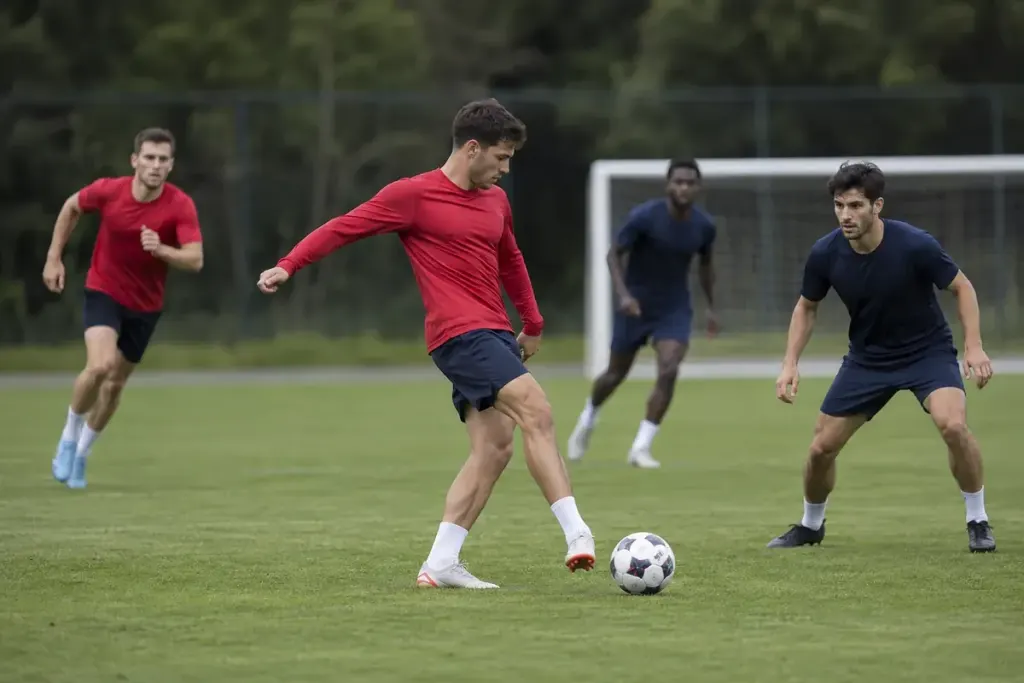
The accompanying generated scene illustrates a passing situation. It does not show a real officiating incident and should not be used to decide an offside call.