
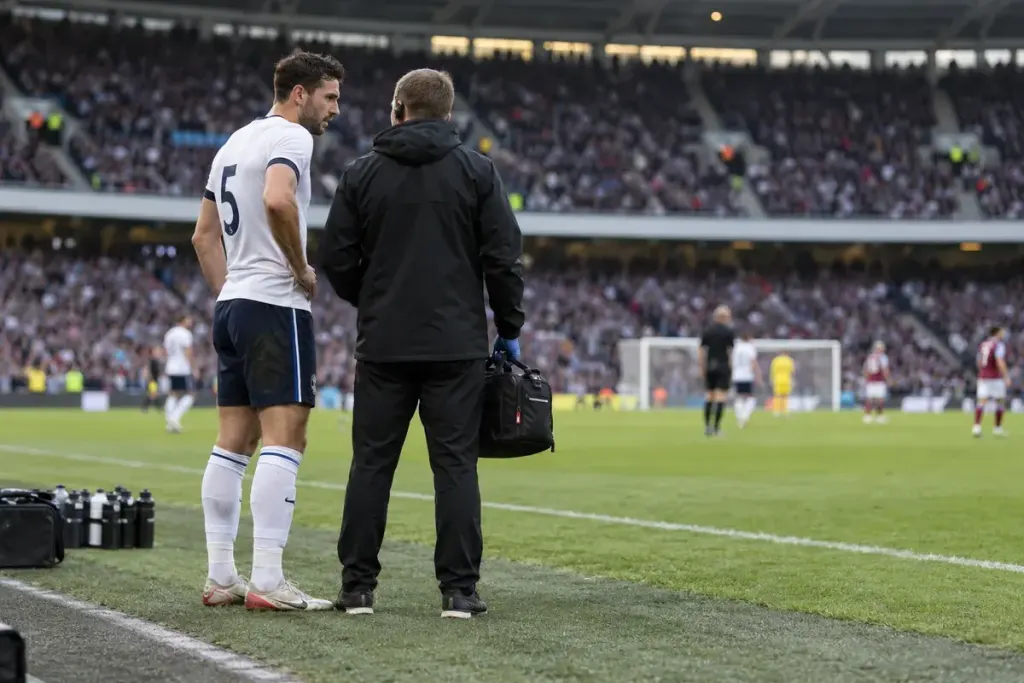
A footballer finishes receiving treatment, stands beside the touchline and appears ready to play. Yet the referee does not immediately wave them back. The medical assessment and the permission to re-enter are separate parts of the procedure.
Under the current IFAB Law 5, an injured player generally has to leave when the injury stops play or delays the restart, with a one-minute period after play restarts before re-entry. The referee’s permission is still required. The law includes exceptions, and the edition and protocols adopted by the competition matter.
Why two injuries can produce different-looking decisions
Exceptions include an injured goalkeeper, certain collisions involving a goalkeeper or players from the same team, severe injury, and an injured player who will take an awarded penalty. Another important case is an injury caused by a physical offence for which the opponent receives a yellow or red card, provided the assessment or treatment is completed quickly.
Consequently, “the medic came onto the pitch” is not enough information to explain the outcome. Watch the incident, the disciplinary decision and whether an exception applies. A player who voluntarily steps off without delaying the restart can also be in a different procedural situation from a player whose injury caused the stoppage.
A better way to follow the next stoppage
Make a short sequence in your match notes: what stopped play, who needed attention, whether a card was shown, how play restarted and when the player was authorised to return. This keeps the rule discussion attached to observable events instead of a guess about how badly someone was hurt.
Do not use the return procedure as evidence that a player is medically fit. That assessment belongs to the medical personnel and the applicable safety protocol. In particular, a suspected serious or head injury is not something to rush because the team wants its full numbers back.
When comparing clips from different seasons or competitions, check the rules in force for each one. An old television example can accurately show an earlier procedure while being a poor guide to the match you are watching today.