
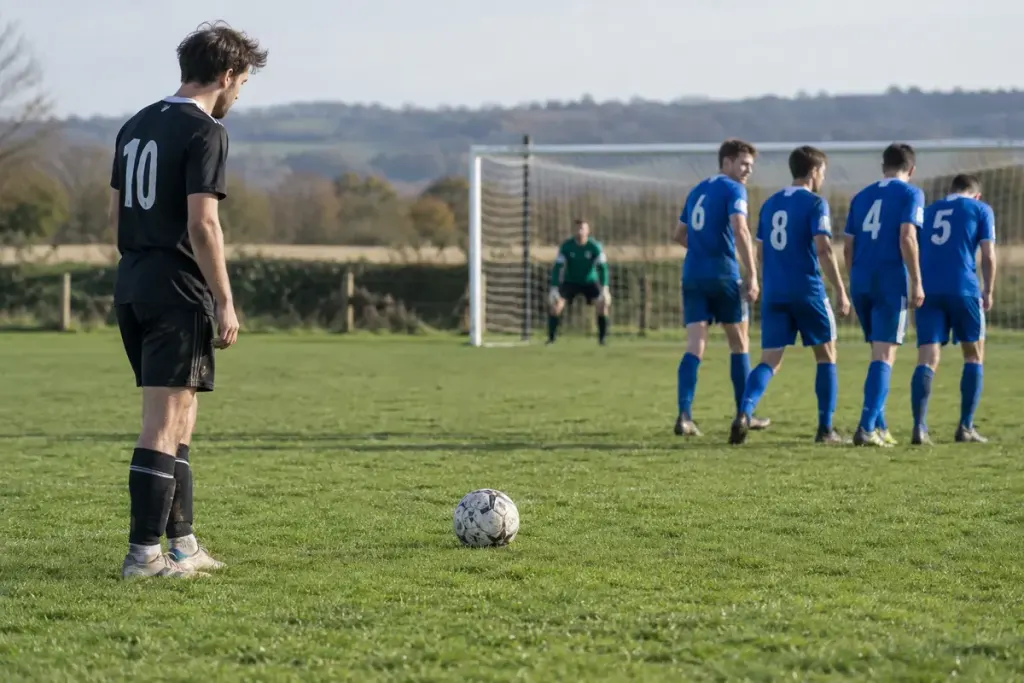
The ball is placed, a teammate runs into space and the free kick is taken immediately. An opponent only a few metres away intercepts it. Supporters shout for the kick to be retaken—but proximity alone does not settle this situation.
IFAB Law 13 makes a specific distinction. If a player takes a free kick quickly and an opponent less than the required 9.15 metres away intercepts, the referee allows play to continue. An opponent who deliberately prevents the kick being taken quickly must instead be cautioned for delaying the restart.
Two sequences that can look similar in a short replay
The kicker chooses the early pass
In an illustrative sequence, a defender is moving away when the attacker decides to restart. The pass goes close enough for the defender to intercept. The fact that the defender has not yet reached the full distance does not automatically give the attacking team a second attempt.
The defender prevents the restart
Now imagine a defender deliberately stepping over the stationary ball to stop the attacker taking the kick. That is a different action. Watch what happened before the pass, rather than judging only the distance visible in the final frame.
These examples explain what to look for; they do not decide every real incident. The referee must assess the actual sequence and the applicable circumstances. A cropped clip may omit an instruction to wait, a disciplinary procedure or the movement that caused the problem.
Watch the restart, not just the interception
For a useful replay review, start before the ball is placed. Identify whether the referee has stopped the restart for a reason, whether the ball is stationary and what the nearby opponent does. Then follow the kick until the ball is clearly moving.
Taking a restart quickly carries a tactical choice: the attacker may gain an unprepared defence but also chooses to play while opponents are still nearby. It does not mean opponents may deliberately block the restart, and it does not mean every intercepted quick pass should be repeated.
Competition procedures and other offences can add detail. For this particular question, the important observation is the opponent’s action before and during the kick, not a distance measurement viewed in isolation.