
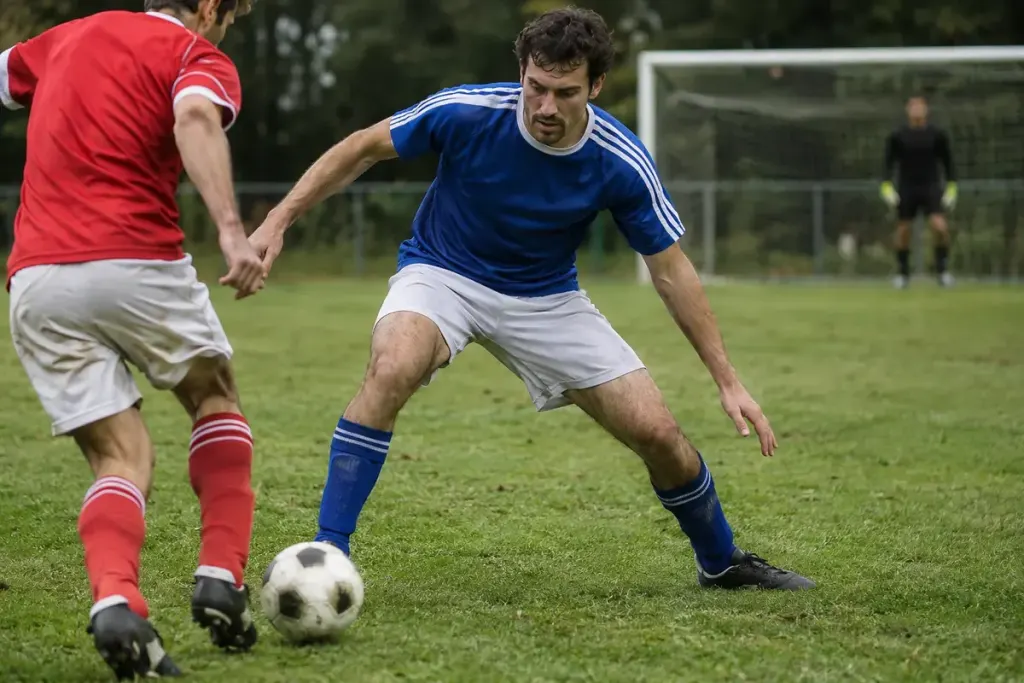
The replay shows a defender touching the ball before it reaches an attacker. Someone immediately says the goal must stand. The missing detail is what kind of touch the defender made. Under the offside law, contact alone does not settle the decision.
Look for the opportunity to play
IFAB Law 11 distinguishes deliberate play from a rebound or deflection. Deliberate play involves control with the possibility of passing, gaining possession or clearing. An unsuccessful attempt can still count as deliberate play; technical failure does not automatically turn it into a deflection.
The IFAB clarification of the distinction points to the circumstances: the ball’s distance and speed, the player’s view, the time available to coordinate movement, and whether the contact was an instinctive stretch. A deliberate movement of the leg is not, by itself, the same as deliberate play in the law.
Watch the sequence before the touch
Consider two illustrative situations. In one, a defender sees a long, predictable pass coming, sets their body and attempts a clearance that goes wrong. In another, a fast ball from nearby strikes an outstretched leg with almost no preparation time. The final contact might look similar in a still image, but the sequence supplies the information the referee needs.
When reviewing a clip, start before the ball reaches the defender. Watch once at normal speed, then use slower playback to inspect details. A frozen frame is good at locating a foot; it is poor at showing how much time the player had.
A deliberate save has its own exception. Stopping or trying to stop a ball going into, or very close to, the goal does not ordinarily remove the earlier offside consideration simply because the save was intentional.
Finally, keep the attacker’s involvement in view. An offside-positioned attacker can interfere with an opponent before any supposed reset. The useful match-day question is therefore more precise than “Did the defender touch it?” Ask what the defender could do, what the attacker did, and which part of the sequence the referee is judging.