
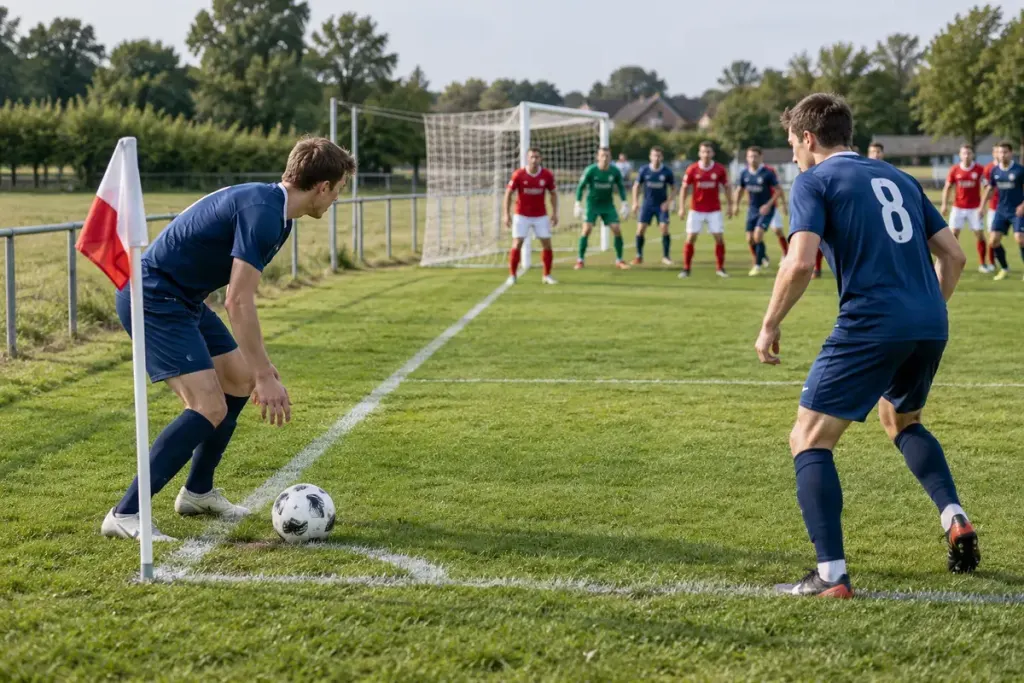
The corner taker rolls the ball a few metres instead of crossing. A groan comes from the crowd, but the useful question is what the short pass makes the defence do. It can alter the delivery angle, draw a defender away or create a different route into the penalty area.
Watch the nearest defender first. Do they leave the box to close the receiver? Does another defender follow, or does the defending side accept a temporary numerical disadvantage near the corner? The attacking move begins to make sense when you see which space has changed.
The second pass tells you more
A short corner is not one fixed routine. The receiver may return the ball, carry it towards a better crossing position or pass backwards to a teammate facing the pitch. Each option changes the angle and the time available to deliver.
Meanwhile, players inside the area can adjust their runs. A defender who was watching both ball and opponent may have to turn, move out or decide whether to track a runner. The routine is often trying to create that decision rather than merely move the ball a short distance.
Track one routine from start to finish
On a replay, note three moments: the starting positions, the first defender’s response and the eventual delivery or reset. Did the attackers gain a clearer passing lane? Did they lose the opportunity because the receiver was immediately trapped? A failed short corner and a well-defended one are not necessarily the same story.
Also watch the players protecting against a counterattack. Committing another player near the corner changes who remains behind the ball. The eventual outcome should be assessed alongside that risk, not only whether a cross reached the box.
Try following two short corners from the same team. If the initial shape is similar but the second pass differs, the first routine may help explain the defender’s reaction to the next. The small pass can be the beginning of the tactical question, rather than a refusal to attack.