
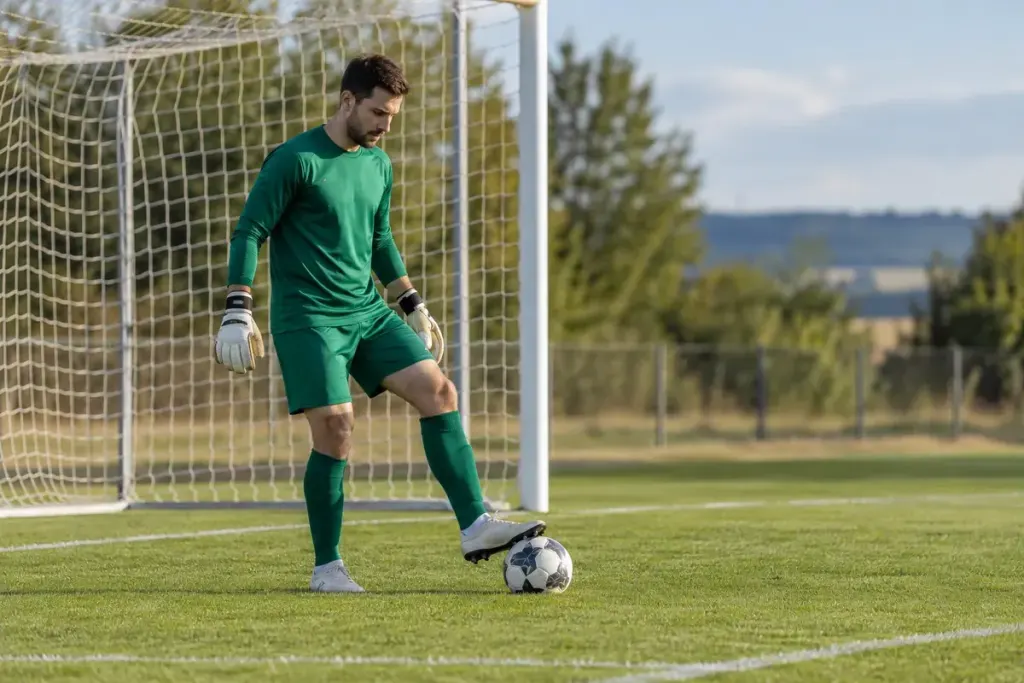
A defender rolls the ball towards their goalkeeper. The keeper controls it with a foot while an opponent closes in. Why not simply pick it up? The answer depends on how the ball arrived, not on whether the goalkeeper is standing inside the penalty area.
Under IFAB Law 12, a goalkeeper is generally not allowed to handle a ball deliberately kicked to them by a teammate, or received directly from a teammate’s throw-in. The law includes an exception when the goalkeeper has clearly kicked or attempted to kick the ball to release it into play. The referee judges what actually happened.
Watch the teammate’s action
A pass can be deliberate even if it is poorly executed. Conversely, a ball that merely deflects off a teammate is not automatically the same as a deliberate kick to the goalkeeper. Watching the contact and intended play is more useful than judging only the direction in which the ball travels.
The familiar name “back-pass rule” can be misleading. The ball does not have to travel backwards. A sideways kick deliberately directed to the keeper can raise the same handling restriction.
A normal header back to the goalkeeper is a different action from a kick. However, the laws also address deliberate tricks using the head, chest or knee to circumvent the restriction. It is not a loophole that allows a player to manufacture an artificial sequence purely to evade the rule.
If the goalkeeper handles the ball in breach of this restriction inside their own penalty area, the restart is an indirect free kick, subject to the laws governing its position. It is not automatically a penalty kick merely because the incident occurred in the box.
On a replay, follow three moments: the teammate’s contact, any genuine attempt by the goalkeeper to kick the ball into play, and the eventual handling. Those details explain far more than the crowd’s immediate reaction.