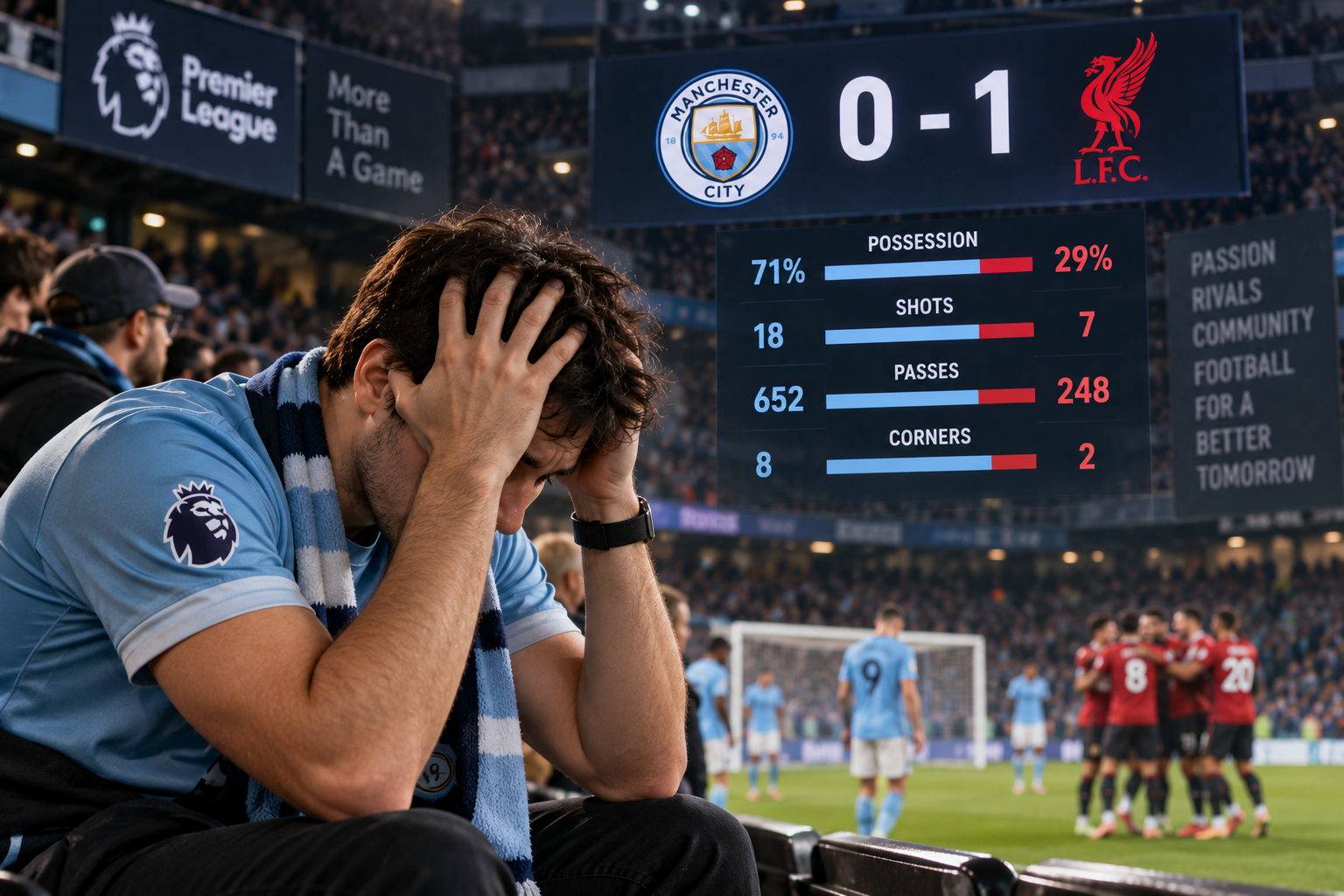
Final whistle.
Score:
1–0.
Your team lost.
Fine.
Annoying, but fine.
Then you open the match statistics.
Possession:
Your team: 71%
Opponent: 29%
Passes?
Your team completed hundreds more.
Corners?
More.
Touches?
More.
Territory?
Probably more.
You stare at the screen.
“How did we lose this?”
Welcome to one of football’s most frustrating lessons:
Having the ball is not the same as controlling the match.
Understanding why possession does not guarantee winning in football requires looking beyond one percentage and asking a much better question:
What did the team actually do with the ball?
Possession Is a Measurement, Not a Score
Football has one statistic that ultimately decides the result.
Goals.
Everything else helps explain how those goals happened.
Possession tells us roughly how much of the match each team spent controlling the ball.
Useful?
Absolutely.
But possession alone doesn’t tell us:
where the ball was,
how dangerous the attacks were,
whether defenders were under pressure,
or whether the team created good chances.
A team can dominate possession without dominating danger.
70% Possession Can Happen 40 Yards From Goal
Imagine this sequence:
Center-back passes to center-back.
Back to goalkeeper.
Goalkeeper to full-back.
Full-back inside.
Midfielder receives.
Back to center-back.
Repeat.
Technically?
Possession.
Danger?
Almost none.
The ball belongs to your team.
But the opponent may be perfectly comfortable.
Location Matters
Compare two teams.
Team A has 70% possession but spends much of it around:
its defensive line,
central midfield,
and harmless wide areas.
Team B has only 30% possession but repeatedly receives the ball:
behind midfield,
inside the penalty area,
or during dangerous counterattacks.
Which team is creating more threat?
Possession percentage alone can’t answer that.
The Opponent May Be Giving You the Ball
This is where football gets interesting.
Fans sometimes assume:
“We have 70% possession, therefore we’re dominating.”
Maybe.
Or perhaps the opponent deliberately decided:
“You can have it there.”
That’s completely different.
Some Teams Want You to Pass Sideways
Opponent drops into a compact defensive shape.
Your center-backs have time.
Your goalkeeper has time.
Even your deepest midfielder has space.
Why?
Because those areas aren’t immediately dangerous.
The defending team may prefer protecting:
central spaces,
the penalty area,
and passing lanes toward dangerous attackers.
They aren’t necessarily losing control.
They may be choosing where you are allowed to have possession.
A Low Block Can Make Possession Look Enormous
One team sits deep.
Ten players behind the ball.
The other team circulates possession outside the defensive shape.
Pass.
Pass.
Pass.
Switch sides.
Pass.
Possession keeps increasing.
But the defensive block barely moves.
This is why matches can finish with one team recording huge possession numbers while producing surprisingly few clear chances.
The Important Question Is: Can You Break the Shape?
Having the ball against a compact defense is step one.
Breaking it?
Much harder.
Teams need ways to create:
space,
overloads,
runs behind defenders,
quick combinations,
crossing opportunities,
or shooting positions.
Without penetration, possession can become decorative.
Sideways Passing Isn’t Automatically Bad
Fans become impatient.
“Forward!”
“Stop passing sideways!”
But sideways circulation has a tactical purpose.
Moving the ball can:
shift defenders,
change the angle of attack,
open passing lanes,
and create space elsewhere.
The problem isn’t sideways passing itself.
The problem is sideways passing that never changes the defensive situation.
Possession Needs to Move the Opponent
Good circulation asks questions.
Will the winger follow?
Will the midfielder step out?
Will the full-back move?
Will a central gap open?
The ball is often used to manipulate defensive positioning.
If defenders never need to adjust, possession may not be accomplishing much.
Tempo Changes Everything
Slow pass.
Control.
Look.
Pass.
Control.
Look.
Against an organized defense?
Plenty of time to reset.
Sometimes the attacking team needs faster ball circulation.
One-touch combinations.
Quick switches.
Immediate forward passes.
The goal isn’t simply moving the ball.
It’s moving the defense faster than it can reorganize.
But Faster Isn’t Always Better
Now the opposite mistake.
Receive ball.
Immediately force forward pass.
Lose possession.
Repeat.
Tempo needs purpose.
Great attacking teams know when to:
accelerate
and
when to recycle.
Football isn’t permanently played at maximum speed.
Vertical Progression Matters
Suppose a team completes 650 passes.
Impressive.
But how many moved the attack meaningfully forward?
Progressive passing can tell us more about whether possession is advancing into threatening areas.
A safe pass may preserve possession.
A difficult forward pass may create an attack.
Teams need both.
Safe Passing Can Become Too Safe
Nobody wants to lose the ball.
So every player chooses the lowest-risk option.
Back.
Sideways.
Back again.
Possession rises.
Creativity disappears.
At some point, attacking football requires accepting controlled risk.
Breaking Lines Creates Problems
Imagine the opponent defending in three layers.
Forwards.
Midfield.
Defense.
Passing sideways in front of the first layer?
Fine.
Passing through that layer into a midfielder between the lines?
Now defenders must react.
Breaking defensive lines can transform harmless possession into dangerous possession.
Receiving Between the Lines Is Valuable
Creative players often search for spaces between:
the opponent’s midfield
and
defensive line.
Receive there.
Turn.
Suddenly:
center-backs must decide whether to step forward,
full-backs narrow,
midfielders recover,
and runners can attack space.
One successful pass can accomplish more than twenty harmless ones.
The First Touch Can Decide the Attack
Perfect pass arrives.
Attacker’s first touch?
Backward.
Defense resets.
Attack disappears.
Receiving technique matters because dangerous spaces often exist for only a moment.
A clean first touch can allow the next action before defenders recover.
Body Position Matters Too
Player receives with back to goal.
Needs several touches to turn.
Different situation.
Player receives already positioned to see:
goal,
teammates,
and defenders.
Now the attack can continue immediately.
Small technical details change the value of possession.
Width Can Stretch a Compact Defense
Opponent packs the center.
What now?
Use width.
Wide players can force defenders to cover more horizontal space.
If the defense stretches?
Central gaps may appear.
If it stays narrow?
Wide players may receive more freely.
Either way, the defense has a decision to make.
But Crossing 40 Times Isn’t Automatically a Solution
Team struggles centrally.
So:
cross.
Cross.
Cross.
Cross.
Final statistics:
42 crosses.
One goal?
Zero.
Crossing can be effective.
But quality depends on:
delivery,
target,
movement,
numbers in the box,
defensive positioning,
and where the cross originates.
Volume isn’t the same as quality.
Crossing From Deep Can Be Easy to Defend
Full-back receives 35 yards from goal.
Launches ball into box.
Center-backs:
thank you very much.
Repeated deep crosses may suit defenders who are strong aerially.
Getting closer to the byline or creating cutback situations can sometimes produce more dangerous angles.
Cutbacks Can Be Extremely Dangerous
Attacker reaches near the goal line.
Defense runs toward its own goal.
Ball pulled backward toward:
penalty spot,
edge of six-yard area,
or arriving midfielder.
Now defenders may be facing the wrong direction.
This type of attack can be more difficult to defend than a predictable high cross.
Possession Doesn’t Tell You Shot Quality
Team A:
18 shots.
Team B:
7 shots.
Team A dominated?
Maybe.
But suppose Team A’s attempts were mostly:
long-range,
blocked,
or from poor angles.
Team B created:
two one-on-ones,
a close-range header,
and a penalty.
Shot count alone can mislead too.
Not All Shots Are Equal
A 30-yard effort and a tap-in both count as:
one shot.
But their probability of becoming goals is dramatically different.
This is why analysts often examine chance quality rather than simply total attempts.
Expected Goals Adds Context
Expected goals, commonly called xG, estimates the probability of chances becoming goals based on characteristics of those shots.
It isn’t perfect.
It doesn’t explain everything.
And it doesn’t decide the actual score.
But it can help distinguish between:
lots of low-quality shooting
and
fewer high-quality chances.
You Can Win the xG Battle and Still Lose
Now football becomes cruel again.
Team creates better chances.
Opponent goalkeeper has an excellent match.
Your striker misses twice.
Opponent scores a difficult chance.
Final:
0–1.
Chance quality increases probability.
It doesn’t guarantee outcomes in one match.
Football contains variance.
That’s why we watch it.
Finishing Matters
Tactical structure creates opportunity.
Someone still has to score.
A beautifully constructed move ending with a poor finish remains:
zero goals.
Sometimes possession-heavy teams lose simply because they fail to convert their best moments.
Goalkeepers Can Rewrite the Match
Striker shoots.
Save.
Again.
Save.
Header.
Save.
Opposition shoots once.
Goal.
Fans:
“How?”
Goalkeeping is part of football.
An outstanding goalkeeper can allow a team to survive periods of pressure and completely change the result.
Counterattacks Can Make 30% Possession Deadly
Your team attacks.
Full-backs push high.
Midfield moves forward.
Center-backs stand near halfway.
Ball lost.
Three seconds later?
Opponent has:
three attackers
against
three defenders.
This is why a team with little possession can still produce the most dangerous moments.
Possession Loss Has Location
Losing the ball near the opponent’s corner flag?
Maybe manageable.
Losing it centrally while six teammates are ahead of the ball?
Danger.
Turnovers become more threatening when defensive structure is compromised.
Rest Defense Matters
This sounds like:
defenders relaxing.
It isn’t.
In tactical language, rest defense broadly refers to how a team positions players behind or around the attack so it can control transitions if possession is lost.
You’re attacking.
But you’re also preparing for the possibility that the attack ends.
Strong possession teams do both simultaneously.
Attacking Structure Is Also Defensive Structure
Full-back goes forward.
Who covers?
Midfielder moves into the box.
Who protects central space?
Center-back steps into midfield.
Who watches the striker?
Every attacking movement changes the defensive picture.
Possession dominance becomes dangerous when too many players attack without protection behind them.
One Bad Turnover Can Undo Ten Minutes of Control
Your team:
passes for ten minutes.
Opponent barely touches the ball.
Then:
misplaced central pass.
Fast counter.
Goal.
Scoreboard:
0–1.
That’s football.
Control needs to survive transitions.
Counterattacking Teams Don’t Need Many Attacks
A team built around transitions may not care about producing 50 attacks.
It may want:
five excellent ones.
If those attacks happen against an unbalanced defense, they can be more dangerous than dozens of slow possessions.
Efficiency matters.
Speed Is Most Dangerous Before the Defense Is Set
Once defenders are organized:
spaces shrink.
During transition:
spaces can be enormous.
This is why quick forwards can terrify possession-heavy teams.
They attack before defenders regain:
shape,
numbers,
and spacing.
The First Pass After Winning the Ball Matters
Defender wins possession.
Option A:
safe sideways pass.
Option B:
immediate forward pass into space.
If the opponent is temporarily disorganized, the second option may create a dangerous transition.
Great counterattacking teams recognize these moments quickly.
Not Every Team Wants “Control” Through Possession
Football philosophy differs.
Some managers believe control comes from:
having the ball.
Others may control:
space,
tempo,
risk,
and defensive zones
without needing constant possession.
A team can feel comfortable with 35% possession if the match is unfolding exactly where it wants.
Defensive Control Is Still Control
Opponent has ball.
But can’t enter penalty area.
Can’t create central combinations.
Can’t get behind defense.
Forced into poor crosses.
Is the defending team being dominated?
Maybe not.
They may be controlling the dangerous spaces.
The Score Changes Tactical Behavior
This is one of the most important things when reading match statistics.
Suppose Team B scores in the 12th minute.
Now Team B leads 1–0.
What might happen?
They may:
defend slightly deeper,
take fewer attacking risks,
and allow Team A more possession.
By full time:
Team A 72%.
Team B 28%.
Did Team A dominate from beginning to end?
Not necessarily.
The early goal changed the match.
This Is Called Game State
The score influences behavior.
At 0–0:
both teams may be balanced.
At 1–0:
leading team becomes more conservative.
At 0–1:
trailing team takes more risk.
At 2–0:
the leader may surrender even more possession.
Statistics should be interpreted alongside game state.
Late Possession Can Inflate the Numbers
Team trails 2–0.
Opponent sits deep for final 25 minutes.
Trailing team dominates the ball.
Final possession:
68%.
Looks impressive.
But much of it occurred when the opponent intentionally protected the lead.
Timing matters.
First-Half and Second-Half Possession Can Tell Different Stories
Full-match averages hide phases.
Maybe possession was:
52–48 before the first goal.
Then:
75–25 afterward.
Looking at match phases can provide more context than the final number alone.
Red Cards Completely Distort Possession
Team receives red card.
Now playing with ten.
Naturally drops deeper.
Opponent dominates the ball.
Final possession statistics become heavily influenced by the numerical advantage.
Again:
context.
Never read one number in isolation.
Set Pieces Don’t Care About Possession
Opponent has 25% possession.
Wins corner.
Perfect delivery.
Header.
Goal.
Possession?
Irrelevant for that moment.
Set pieces can allow teams to create major scoring opportunities without building long periods of open-play control.
Corners Can Equalize Tactical Differences
A technically superior team may dominate open play.
But if the opponent is excellent at:
corners,
free kicks,
long throws,
and aerial duels,
the match can remain dangerous.
One set piece can erase an hour of possession dominance.
Defending Set Pieces Is Part of Controlling a Match
Fans sometimes say:
“We completely controlled them except for set pieces.”
But set pieces are part of the game.
If an opponent repeatedly wins dangerous dead-ball situations, that’s meaningful.
Control includes preventing avoidable opportunities.
Fouls Can Create Cheap Territory
Counterattack begins.
Defender fouls.
Free kick.
Ball enters penalty area.
Suddenly a team that barely had possession has a dangerous scoring opportunity.
Disciplined defending matters.
Corners Can Also Create Counterattacks
Your team wins corner.
Everyone forward.
Delivery cleared.
Opponent winger runs.
Now what?
Attacking set pieces need defensive preparation too.
Another example of attack and defense being connected.
Pressing Can Make Possession Uncomfortable
Possession percentage says:
60%.
But every pass happens under pressure.
Center-back receives.
Striker presses.
Pass to full-back.
Winger presses.
Back inside.
Midfielder trapped.
Turnover.
Possession exists.
Control?
Questionable.
Some Teams Allow the First Pass
Goalkeeper to center-back.
No pressure.
Center-back moves forward.
Still no pressure.
Then passes into midfield.
Suddenly:
trap.
Several defenders collapse.
Pressing isn’t always about chasing the ball constantly.
Sometimes it’s about waiting for a specific trigger.
Pressing Traps Can Make “Safe” Passes Dangerous
Opponent deliberately leaves one player appearing open.
Pass goes there.
Immediately:
multiple defenders close space.
The receiving player has limited options.
Turnover.
What looked like available possession was actually bait.
Passing Accuracy Can Be Misleading Too
Team completes 92% of passes.
Excellent.
But if most are low-risk passes among defenders?
Different from completing difficult passes through pressure.
Accuracy needs context.
Risk Changes Passing Numbers
Creative midfielder attempts ten difficult passes.
Completes six.
Center-back attempts fifty safe passes.
Completes forty-nine.
Who contributed more attacking value?
Can’t answer from percentage alone.
Statistics describe actions.
Interpretation explains them.
Progressive Carries Can Break Defensive Lines
Passing isn’t the only way forward.
A defender or midfielder carrying the ball can force opponents to step out.
Once a defender commits?
Space may open behind.
Ball-carrying can disrupt defensive shapes that are comfortable against predictable passing.
Dribblers Create Chaos
Organized defense loves predictability.
Then winger beats full-back.
Suddenly another defender must help.
Midfielder covers.
Center-back shifts.
Structure changes.
One successful dribble can create a chain reaction.
Individual Quality Still Matters
Tactics can create the right situation.
Then football becomes personal.
Can the winger beat the defender?
Can the midfielder execute the pass?
Can the striker finish?
Can the goalkeeper save?
Strategy creates opportunities for individual skill.
It doesn’t replace it.
Movement Without the Ball Creates Space
Possession analysis often follows the ball.
But watch the players without it.
Striker moves toward near post.
Defender follows.
Winger attacks space behind.
Midfielder makes third-man run.
Suddenly passing options appear.
Good possession depends heavily on people who aren’t touching the ball.
Static Attackers Make Defending Easy
Everyone wants ball to feet.
Nobody runs behind.
Nobody rotates.
Nobody drags defenders away.
The possession team may have technical quality but become predictable.
Movement creates uncertainty.
Runs Behind Stretch the Defensive Line
Defense pushes high.
Forward threatens space behind.
Now defenders face a choice.
Step forward?
Risk through ball.
Drop deeper?
Create more space in midfield.
Even when the pass isn’t played, the run can influence defensive positioning.
The Best Run May Never Receive the Ball
Winger runs.
Full-back follows.
Central space opens.
Midfielder scores.
Winger never touched the ball.
Stat sheet?
No assist.
Tactical contribution?
Huge.
This is why watching football remains essential even in an era of advanced statistics.
Overloads Can Create Free Players
Three attackers against two defenders on one side.
Someone becomes free.
The defending team shifts additional support.
Now space may open elsewhere.
Possession becomes dangerous when it creates numerical advantages in useful areas.
Switching Play Punishes Over-Compact Defenses
Attack develops on left.
Defense shifts left.
Quick switch to right.
Now winger may receive:
space,
time,
and a one-on-one.
But the switch must arrive quickly enough.
Slow circulation gives the defense time to move across.
One-on-One Ability Can Unlock Low Blocks
Sometimes tactical structure works.
Winger receives isolated against full-back.
Now:
beat your defender.
Not every solution requires a complex passing pattern.
Individual dribbling can create the breakthrough.
Central Overloads Can Be Even More Valuable
Teams may position extra players inside to dominate midfield.
Advantages?
More passing options.
Better counterpressing positions.
Potential access between lines.
But crowding the center can also reduce width.
Every tactical choice creates trade-offs.
Full-Backs Often Provide the Width
Modern football frequently asks full-backs to become major attacking players.
They may:
overlap,
underlap,
move into midfield,
or remain deeper.
Their role affects both:
chance creation
and
transition defense.
An Overlap Can Create Two Problems for One Defender
Winger has ball.
Full-back runs outside.
Defender must choose:
follow runner
or
stay with winger.
Hesitation creates opportunity.
Simple movement.
Powerful effect.
Underlaps Attack Different Space
Instead of running outside, a supporting player moves inside the winger.
This can attack gaps between:
full-back
and
center-back.
Different defensive question.
Same goal:
create uncertainty.
The Penalty Area Needs Occupation
Great build-up.
Winger reaches crossing position.
Looks up.
Nobody there.
Possession without penalty-box presence limits attacking threat.
Teams need enough players arriving in scoring areas.
But Sending Everyone Into the Box Creates Counter Risk
Again:
trade-offs.
More attackers forward?
More potential targets.
But fewer players protecting transitions.
Managers constantly balance:
attacking numbers
against
defensive security.
Second Balls Matter
Cross cleared.
Who gets the next ball?
Possession teams often position midfielders around the penalty area to recover clearances.
Win second ball?
Attack continues.
Lose it?
Counterattack begins.
These moments strongly influence whether pressure becomes sustained.
Counterpressing Can Keep Opponents Trapped
Lose possession.
Instead of immediately retreating, nearby players pressure the ball.
If they recover it quickly?
Opponent never escapes.
This can make possession dominance feel suffocating.
But Failed Counterpressing Is Dangerous
Several players rush toward the ball.
Opponent escapes with one pass.
Now those players are behind the play.
Open space.
Counterattack.
Aggressive pressing creates rewards and risks.
Fatigue Changes Pressing Quality
First 20 minutes:
perfect pressure.
Minute 75:
one player arrives late.
Passing lane opens.
Defensive line exposed.
Physical condition influences tactical execution.
A strategy only works if players can continue performing it.
Fixture Congestion Can Affect Possession Matches
Premier League clubs may also compete in:
domestic cups,
European competitions,
and international fixtures.
Short recovery periods can influence:
pressing intensity,
rotation,
sharpness,
and decision-making.
This is one reason the context surrounding upcoming Premier League fixtures matters when evaluating how teams may approach matches.
Rotation Can Change Ball Progression
Regular midfielder rested.
Replacement is a good player.
But perhaps different.
One progresses through passing.
Another carries the ball.
One plays quickly between lines.
Another prefers safer circulation.
Personnel changes can alter possession patterns without changing the overall formation.
Formations Don’t Tell the Entire Story
Graphic says:
4-3-3.
Fine.
With ball?
Maybe:
3-2-5.
Without ball?
4-4-2.
During buildup?
2-3-5.
Football formations are dynamic.
The television graphic before kickoff is only a starting point.
Watch Where Players Actually Stand
Want to understand possession better?
Ignore the formation graphic for a few minutes.
Watch:
Where are the full-backs?
How high are the center-backs?
Where does the defensive midfielder receive?
Are wingers wide?
Who enters the box?
Where are players positioned after possession is lost?
Now the tactical picture becomes clearer.
Possession Can Be Defensive
Leading 2–0.
Ten minutes left.
Team passes:
back,
sideways,
back,
sideways.
Fans may want another attack.
Manager may want:
the match to end.
Keeping possession can deny the opponent opportunities.
Not all possession is intended to create chances.
Sometimes the ball itself is defensive protection.
The Opponent Can’t Score Without the Ball
Usually.
Unless you create your own spectacular defensive disaster.
Possession can reduce opponent attacking time.
That’s one reason ball-dominant teams often use possession as part of their defensive strategy.
But One Turnover Can Still Be Enough
Control ball for three minutes.
Bad pass.
Counterattack.
Goal.
Possession reduces some risks.
It doesn’t eliminate transition vulnerability.
Match Control Is Multidimensional
Real control can involve:
possession,
territory,
chance quality,
transition prevention,
set-piece management,
tempo,
and game state.
A team controlling several of these dimensions is more convincingly dominant than one simply owning the ball.
Territory Can Matter More Than Raw Possession
Where is the game happening?
If one team keeps the opponent pinned near its penalty area, that’s meaningful.
If possession happens mostly near halfway?
Different story.
Territorial dominance adds context.
Field Tilt Can Help Describe Territory
Analysts sometimes use metrics such as field tilt to examine which team controls attacking areas.
Different models calculate this differently, but the broader idea is useful:
Where is meaningful possession occurring?
Again, location.
Penalty-Area Touches Can Reveal Threat
How often does a team actually get the ball into dangerous areas?
A possession-heavy team with very few touches inside the opponent’s box may be struggling to penetrate.
Meanwhile, a counterattacking team can produce fewer total touches but more meaningful ones.
Big Chances Can Tell Another Story
Final statistics:
Possession 72–28.
Shots 17–8.
Looks dominant.
Big chances:
1–4.
Suddenly?
Different match.
No single metric is perfect.
But combining several gives a more complete picture.
Watch the Type of Chances
Did the team create:
one-on-ones?
cutbacks?
close-range shots?
free headers?
Or mostly:
blocked attempts
and
long shots?
The box score begins to make sense when you connect numbers to actual situations.
Long Shots Can Be a Symptom
Compact defense refuses entry into penalty area.
Possession team becomes frustrated.
Shoot from 25 yards.
Again.
Again.
High shot count.
Low threat.
Repeated long-range attempts may indicate that the defense successfully protected more valuable areas.
Sometimes a Long Shot Is Exactly the Right Choice
Defenders refuse to step out.
Midfielder has space.
Excellent shooter.
Take it.
A credible long-range threat can force defenders to close down.
Then?
Space may open elsewhere.
Football solutions interact.
Goals Change Space
Team scores.
Opponent must attack more.
Defensive block moves higher.
More space appears.
Suddenly the team that struggled for 60 minutes begins creating chances easily.
Why?
Game state changed the geometry.
Chasing the Match Creates Risk
Trailing team sends more players forward.
Creates pressure.
But also leaves:
larger spaces,
fewer defenders,
and more counterattacking opportunities.
This is why late scorelines can become misleadingly large.
A 1–0 match can become 3–0 because the losing team had to gamble.
A 3–0 Score Doesn’t Always Mean Total Domination
Maybe.
But perhaps:
match was balanced,
first goal came late,
losing team opened up,
then conceded two counters.
Scorelines contain information.
Not complete narratives.
The Same Applies to 1–0
Winning team had 25% possession.
Does that automatically mean lucky?
No.
Maybe they:
defended brilliantly,
created the best chances,
executed their game plan,
and protected the lead.
Or maybe they were extremely fortunate.
You need to watch the match and examine context.
Luck Exists in Football
Deflection.
Post.
Goalkeeper mistake.
Striker misses open goal.
VAR decision.
Ball rebounds perfectly.
Over a season, quality tends to matter enormously.
In one match?
Randomness can have a large effect.
That’s Why One Match Doesn’t Prove Everything
Team loses despite dominant possession.
Headline:
“System doesn’t work.”
Maybe.
Or perhaps they created excellent chances and simply didn’t finish them.
Evaluate patterns across multiple matches.
Not just one frustrating Saturday.
Repeated Sterile Possession Is Different
One match:
bad finishing.
Ten matches:
70% possession,
few good chances,
same problems breaking low blocks.
Now we may be seeing a structural issue.
Patterns matter.
Look at What Keeps Repeating
Does the team consistently struggle against:
deep defenses?
high pressing?
quick counterattacks?
set pieces?
physical forwards?
These repeated situations tell us more than possession percentage alone.
Opponent Style Matters
A possession team may look excellent against another team willing to attack.
More space.
More transitions.
Then face a compact low block.
Everything becomes difficult.
Football is about interactions between styles.
There Is No Tactic That Beats Everything
High press?
Can be bypassed.
Low block?
Can be stretched.
Possession?
Can be countered.
Counterattack?
Can be denied space.
Every system has strengths and weaknesses.
The challenge is adapting.
Substitutions Can Change the Match
Possession isn’t producing chances.
Manager introduces:
another winger,
creative midfielder,
second striker,
or attacking full-back.
Shape changes.
Defensive risk changes.
Suddenly the match becomes different.
Substitutions are tactical decisions, not simply fresh legs.
The Bench Can Solve Specific Problems
Need:
width?
pace?
aerial presence?
creativity?
defensive control?
Different substitutes offer different solutions.
Squad construction matters because matches create different tactical problems.
A Target Forward Can Change Possession
Opponent defends compactly.
Introduce strong aerial striker.
Now crosses become more threatening.
Center-backs become occupied.
Second balls become important.
The attacking method changes without abandoning possession.
Pace Can Stretch Tired Defenders
Minute 75.
Full-back tired.
Fresh winger enters.
First sprint?
Problem.
Bench speed can create situations that weren’t available earlier.
Sometimes the Best Substitution Is in Midfield
Fans want:
another striker.
Manager adds midfielder.
Why?
Maybe the team needs better:
ball progression,
counterpressing,
or control between lines.
More attackers doesn’t automatically mean more attacking threat.
Five Forwards Can Make a Team Worse
Need goal.
Remove midfielders.
Add attackers.
Now nobody can deliver the ball effectively.
Team becomes disconnected.
Football requires structure.
Not simply maximum number of strikers.
Learn to Watch the Match Behind the Ball
Next Premier League match?
Try something.
For five minutes, don’t follow the ball exclusively.
Watch the defensive midfielder.
Then watch a full-back.
Then watch the striker when their team doesn’t have possession.
You’ll notice an entirely different game.
Ask Better Questions During Possession
Instead of:
“Why aren’t they passing forward?”
Ask:
What is the defense protecting?
Who is trying to create space?
Which passing lane is blocked?
Where is the free player?
What happens if possession is lost?
Suddenly football becomes much more interesting.
A Simple Way to Read Possession
Think about four questions.
1. Where?
Where does the team have the ball?
Own half?
Final third?
Penalty area?
2. Why?
What is possession trying to accomplish?
Build attack?
Move defense?
Protect lead?
Recover physically?
3. What Happens Next?
Does possession create:
a chance,
territorial progress,
or nothing?
4. What Happens When It Is Lost?
Can the team:
recover immediately,
defend transition,
or become exposed?
Those four questions reveal much more than the percentage.
Try the “Five-Minute Test”
Watch five minutes of a match.
Ignore possession statistics.
Ask:
Which team looks more likely to score?
Then check:
where attacks begin,
how they progress,
and what chances appear.
You may discover the team with less possession feels more dangerous.
Don’t Let the Stat Graphic Watch the Match for You
Television displays:
Possession 68%.
Shots 14.
Pass accuracy 91%.
Useful.
But football still happens on the pitch.
Statistics help us understand.
They shouldn’t replace observation.
The Best Analysis Combines Both
Eye test alone?
Can miss patterns.
Statistics alone?
Can miss context.
Combine:
what happened
with
how often it happened.
That’s where match analysis becomes more useful.
FAQ
Does having more possession mean a football team played better?
Not necessarily. Possession shows how much a team controlled the ball, but it does not show where possession occurred or how dangerous it was. Chance quality, territory, transitions, defensive organization and game state also matter.
How can a team win with only 30% possession?
A team can defend compactly and use quick counterattacks, set pieces or a small number of high-quality chances. Football rewards goals rather than time spent on the ball.
Why do teams pass sideways so much?
Sideways passing can move defenders, change attacking angles and create space elsewhere. It becomes ineffective when circulation fails to disrupt the opponent’s defensive shape or produce progression.
What is a low block in football?
A low block is a defensive approach where a team positions many players relatively close to its own goal, prioritizing compactness and protection of dangerous spaces.
Why are counterattacks dangerous against possession teams?
Possession teams often move several players forward. If they lose the ball while poorly positioned defensively, opponents may attack open space before the defense can reorganize.
Is expected goals more useful than possession?
They measure different things. Possession describes control of the ball, while expected goals attempts to estimate chance quality. Neither statistic should be interpreted completely in isolation.
Why does possession often increase when a team is losing?
The leading team may become more conservative and defend deeper, allowing the trailing team to control more of the ball. This is one example of how game state influences match statistics.
Conclusion
Final whistle.
Your team lost:
1–0.
Possession?
70%.
Passes?
Hundreds more.
You look at the numbers again.
But now you ask different questions.
Where was the possession?
Did it break defensive lines?
Did anyone run behind?
Were there meaningful touches in the box?
Were the shots actually dangerous?
What happened after turnovers?
Did the opponent intentionally allow harmless possession?
Did the score change how both teams played?
Suddenly the result becomes less mysterious.
Because football isn’t a competition to see who can keep the ball longest.
The ball is a tool.
Some teams use it to:
create chances,
control territory,
or protect themselves.
Other teams willingly give up possession so they can attack:
space,
transitions,
and mistakes.
Both approaches can work.
So the next time your team finishes with 70% possession and loses?
You can still be angry.
That’s part of being a football fan.
But at least don’t shout:
“WE HAD THE BALL MORE, SO WE SHOULD HAVE WON!”
The scoreboard has never cared.