Watch a Premier League match for a few minutes and something can look completely wrong.
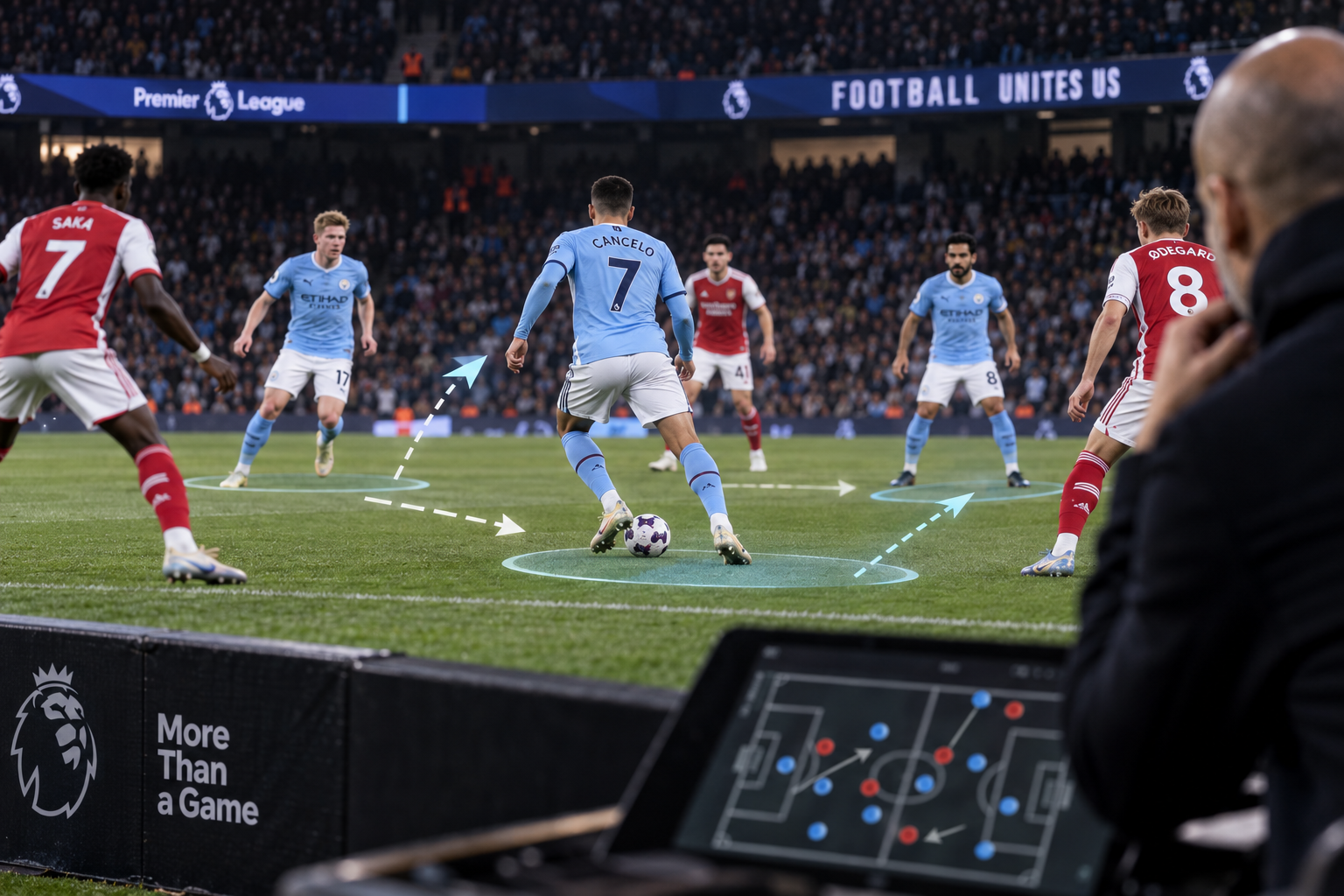
The team has possession. The left-back receives the ball, but instead of staying close to the touchline, he moves toward central midfield. On the opposite side, the winger stays extremely wide while a midfielder pushes higher between the lines.
For someone familiar with the traditional idea of a full-back, the positioning can seem almost backwards.
Yet this movement has become an important tactical tool in modern football. Understanding inverted full backs in football helps explain how Premier League teams create midfield overloads, protect themselves against counterattacks, open passing lanes, and give attacking players more freedom.
The Traditional Full-Back Had a Clearer Job
Traditionally, the full-back’s positioning was easier to recognize.
Stay relatively wide.
Defend the flank.
Support the winger.
Overlap when possible.
Deliver crosses.
Recover quickly when possession is lost.
That role still exists, and plenty of teams continue to use overlapping full-backs. But modern positional football has expanded what defenders are expected to do when their team controls possession.
A full-back may now become a temporary midfielder.
What Is an Inverted Full-Back?
An inverted full-back is a wide defender who moves toward central areas when the team has possession rather than automatically advancing along the touchline.
Imagine a left-back receiving the ball.
Instead of running outside the left winger, he moves inside toward the defensive midfielder.
The winger remains wide.
Suddenly the team has an extra player in central midfield.
The full-back has not permanently changed position. His role changes according to the phase of play.
It Starts With the Problem of Space
Football tactics are heavily influenced by where players stand relative to opponents.
If every player simply occupies their traditional position, the defending team can often match those positions relatively easily.
Modern possession structures try to create situations where the opponent must make uncomfortable choices.
Should the winger follow the full-back inside?
Should a central midfielder step forward?
Should the striker drop deeper?
Every defensive movement can open another space.
The inverted full-back is useful because his movement changes the geometry of the midfield.
An Extra Midfielder Can Create an Overload
Suppose the defending team has two central midfielders.
The team in possession also has two midfielders.
That area is balanced.
Now a full-back steps inside.
The attacking team effectively has three players in the same central zone.
This creates a numerical overload.
One defender may now have to choose between two passing options.
Even if the extra player never receives the ball, his presence can alter the opponent’s defensive shape.
The Full-Back Does Not Need to Become the Playmaker
“Inverting” does not automatically mean the defender suddenly becomes the team’s creative midfielder.
Sometimes the role is relatively simple.
Receive.
Recycle possession.
Offer a safe passing option.
Help circulate the ball.
Cover behind attacking teammates.
The tactical value often comes from positioning rather than spectacular passing.
A player can influence a possession sequence simply by standing somewhere the opponent cannot comfortably ignore.
Moving Inside Can Open the Wing
This sounds contradictory.
A full-back leaves the flank, yet the team can become wider.
Why?
Because the winger no longer needs to share the same outside corridor with the full-back.
The winger can remain extremely wide near the touchline.
That stretches the defending team horizontally.
If an opposition full-back moves toward the winger, gaps may appear between defenders.
If they remain narrow, the winger may receive the ball with more space.
The inverted defender and wide winger therefore complement each other.
Compare It With a Traditional Overlap
In a traditional overlap, the winger may move inside while the full-back runs around the outside.
That creates width through the defender.
With an inverted full-back, the relationship can reverse.
The winger holds the width.
The full-back occupies the inside channel.
Neither approach is automatically superior.
They create different problems for the defense.
A good tactical system chooses movements that suit the players and the opponent.
The Half-Space Becomes Important
Modern tactical analysis frequently uses the term half-space.
Imagine dividing the pitch vertically.
There is the central corridor, the two wide corridors near the touchlines, and spaces between them.
Those inside-wide channels are commonly described as half-spaces.
They are valuable because players operating there can often see multiple directions of play.
They may pass centrally, combine wide, or attack forward.
An inverted full-back can help occupy or support these areas.
Central Positioning Creates Better Passing Angles
A full-back standing directly on the touchline has fewer directions available.
The sideline effectively removes one side of the pitch.
Move that player inward and the passing geometry changes.
They may connect with:
The center-backs.
The defensive midfielder.
Advanced midfielders.
The opposite side.
The winger.
The striker between lines.
This does not guarantee progression, but it can give the team more options when building possession.
It Can Help Beat the First Line of Pressure
Premier League pressing structures can make early buildup difficult.
Opponents may send several players toward center-backs and the holding midfielder.
An inverted full-back can provide another central passing option.
Now the pressing team has another player to account for.
If they ignore him, he may receive freely.
If someone steps toward him, another passing lane can open.
This is why buildup is often about manipulating pressure rather than simply passing around it.
Pressing Is a Chain Reaction
Imagine an opposition winger moves inside to follow the inverted full-back.
Who now covers the wide player?
Perhaps the opposition full-back must step higher.
That can leave space behind.
Perhaps a central midfielder moves across instead.
Now central space changes.
Every defensive adjustment creates another consequence.
High-level positional football constantly searches for these chain reactions.
The Goal Is Often to Create the Free Player
Possession is not valuable simply because a team completes many passes.
The important question is whether the structure can produce a player with time and space.
That player might be the inverted full-back.
But often he is only the mechanism that frees someone else.
His movement attracts an opponent.
The ball goes somewhere different.
The tactical contribution may never appear in basic statistics.
Inverted Full-Backs Can Support the Number Six
A lone defensive midfielder can become easy to isolate.
Opponents know where the central outlet will be and can block the passing lane.
When a full-back moves alongside or near the number six, the structure changes.
The team may temporarily create a double pivot.
That gives center-backs multiple options when progressing possession.
It can also make it harder for one opposition forward to screen the entire midfield.
The Shape With the Ball Can Look Nothing Like the Formation
A lineup might be shown as 4-3-3 before kickoff.
That describes only part of the story.
Once possession begins, the team might resemble a 3-2-5.
Or 2-3-5.
Or another structure depending on which players move.
A full-back may step into midfield.
A midfielder may advance.
A winger stays wide.
A center-back shifts across.
This is why formation graphics alone cannot fully explain modern football.
The Defensive Formation and Possession Shape Are Different Things
When possession is lost and the team retreats, the inverted full-back may return to the traditional defensive line.
The team becomes a back four again.
Win the ball.
The structure transforms.
This constant shape-changing is central to modern tactics.
Positions have become increasingly phase-dependent.
A player can effectively perform multiple positional functions during one sequence.
Why Not Just Play Another Midfielder?
It is a reasonable question.
If the team wants an extra central midfielder, why use a defender there?
Because the team still needs defensive coverage.
Starting with a back four provides one structure without possession.
Then moving one defender inside creates another structure with possession.
The team gains tactical flexibility without making a permanent substitution or formation change.
One player effectively connects two systems.
It Can Improve Counterattack Protection
The benefits are not purely offensive.
Imagine both full-backs sprinting high and wide.
If possession is lost, enormous spaces may exist beside the center-backs.
Now imagine one full-back is already positioned centrally behind the attack.
When the ball is lost, that player may be closer to the area where a counterattack begins.
This can improve what coaches often call rest defense.
Rest Defense Has Nothing to Do With Resting
The phrase can sound strange.
Rest defense describes how a team positions players behind or around the attack while it has possession.
Those players are preparing for what happens if possession is lost.
How many players remain?
Where are they positioned?
Which spaces can they protect?
Can they stop the first forward pass?
An inverted full-back can become an important part of this structure.
Losing the Ball Is Part of Attacking Strategy
Strong attacking teams do not think only about how to create a chance.
They also consider what happens if the attack fails.
If too many players occupy advanced positions without protection, one misplaced pass can expose the entire defense.
Central positioning from a full-back can provide another body behind the ball.
That makes aggressive attacking structures safer.
Counterpressing Becomes Easier When Players Are Connected
When possession is lost, the closest players often try to regain it immediately.
This is counterpressing.
For counterpressing to work, players need useful distances between them.
If the team is stretched across enormous areas, opponents can escape pressure more easily.
An inverted full-back can help keep the central structure compact.
The team may then surround the ball more quickly after losing it.
But Inverting Creates New Risks
No tactical idea gives something for free.
When the full-back moves inside, the space they normally defend can become exposed.
If possession is lost and the opponent quickly reaches that flank, the defender may need to recover outward.
That can be difficult.
Especially against fast wingers.
The system therefore depends on the positioning of other players.
The Center-Back May Need to Defend Wider
If the full-back is central when possession turns over, the nearest center-back may have to move toward the flank.
That asks different questions of the defender.
Can they defend large spaces?
Are they comfortable in one-on-one situations?
Do they have enough recovery speed?
Can the remaining defenders reorganize behind them?
A tactical structure only works if the players can perform the responsibilities it creates.
Pace Can Punish Poor Rest Defense
Premier League transitions happen quickly.
A team may spend a minute carefully constructing possession and lose control with one pass.
Within seconds, the opponent can attack the space behind.
That is why the positioning of inverted full-backs cannot be viewed only through possession statistics.
Their value becomes equally visible during the first moments after a turnover.
The Role Requires Excellent Awareness
A traditional touchline position gives a player a relatively clear picture of where pressure can arrive.
Central midfield is different.
Opponents can approach from multiple directions.
An inverted full-back needs to scan constantly.
Where is the pressure?
Where is the midfielder?
Can the ball be played forward?
Is the winger available?
Is there space behind?
Receiving centrally without awareness can turn a tactical advantage into a dangerous turnover.
Body Orientation Becomes Critical
Receiving a pass is not only about controlling the ball.
The direction a player’s body faces influences what can happen next.
A player receiving with a closed body may need extra touches before seeing forward options.
A player positioned more openly can sometimes receive and immediately connect with another area.
In central spaces, those fractions of a second matter.
Pressure arrives quickly.
Good body orientation helps the inverted full-back play efficiently.
Technical Security Matters More Than Flash
The role does not necessarily require endless tricks.
It requires reliability.
First touch.
Short passing.
Awareness.
Receiving under pressure.
Turning when appropriate.
Knowing when not to turn.
Protecting the ball.
A mistake in central midfield can be much more dangerous than losing possession near the touchline.
That is why coaches need players they trust technically.
Decision-Making Separates Good Inversion From Random Movement
Moving inside does not automatically help.
The player must understand when to move.
How far.
Which line to occupy.
Whether another midfielder is already there.
When to remain wider.
When to drop.
When to advance.
Poor spacing can result in three teammates occupying the same zone while another area is completely empty.
Tactical movement only creates value when it improves the overall structure.
Sometimes the Full-Back Moves Into Midfield Before Receiving
This is the easiest version to notice.
The defender begins wide, then drifts inside as possession develops.
A center-back finds him centrally.
From there, the ball can move forward or across the pitch.
But inversion can also happen without the player receiving.
The movement itself changes the opposition’s positioning.
Off-ball tactical value is one reason these systems can be difficult to understand from highlight clips.
Sometimes the Full-Back Becomes Part of the Midfield for Long Periods
In some systems, the role is more permanent during possession.
The defender consistently operates next to a holding midfielder.
This creates a recognizable central platform behind the attacking line.
From there, the team can circulate possession and protect transitions.
The player may spend so much time centrally that casual viewers begin wondering whether they are still technically a full-back.
Without possession, the answer becomes clearer.
Sometimes Only One Full-Back Inverts
Symmetry is not required.
One full-back may move inside while the other remains wider or pushes higher.
This creates an asymmetric structure.
For example, the team might effectively form a back three because one defender stays deeper while the opposite full-back enters midfield.
Asymmetry can make buildup less predictable.
It also allows teams to adapt roles to individual player strengths.
Both Full-Backs Can Also Move Inside
Some systems bring both wide defenders into narrower positions.
This can create a strong central presence behind the attacking players.
The wingers then become especially important for maintaining width.
Again, the benefit comes with trade-offs.
Wide transition spaces may become vulnerable if the ball is lost.
The structure must be supported by good counterpressing and defensive awareness.
A Center-Back Can Perform a Similar Movement
Modern tactical roles increasingly blur traditional labels.
A center-back may step into midfield during buildup.
A midfielder may drop into the defensive line.
A full-back may become a number six.
The underlying principle matters more than the player’s starting label.
Teams are trying to place the right number of players in useful spaces during each phase.
The Opponent Determines Whether Inversion Works
A structure that dominates one opponent may struggle against another.
Suppose the opposition defends very narrow.
Adding another player centrally might create congestion instead of useful superiority.
Against another team, the inverted full-back might constantly become the free player.
Coaches therefore adjust positioning based on pressing schemes, defensive blocks, and available spaces.
Football tactics are interactive.
The opponent gets a vote.
Man-Marking Creates Different Problems
Against aggressive man-oriented pressure, an inverted full-back may drag an opponent into unfamiliar territory.
That can create space elsewhere.
But it can also make buildup difficult if every central player is tightly followed.
The team may then use rotations.
One player drops.
Another moves higher.
A winger comes inside.
The full-back changes position again.
The objective is to disrupt the defensive references.
Against a Low Block, the Role Changes
When the opponent retreats near its own penalty area, buildup pressure may no longer be the main problem.
Now the challenge is creating chances against compact defenders.
The inverted full-back can help circulate the ball around the block and protect against counterattacks.
But the attacking team may also need more width, overlaps, underlaps, or runners behind the defense.
The same player can therefore perform a different function later in the possession.
Inverting Does Not Mean Never Overlapping
This is an important misconception.
A player can invert during one phase and overlap later.
Football movements are dynamic.
The full-back may begin centrally to help progression.
The ball reaches the winger.
An opportunity appears.
Now the defender runs outside.
Rigid labels can make tactics seem more fixed than they really are.
Good players respond to space.
Underlapping Is Another Option
An underlap is a forward run inside the wide player rather than outside them.
If the winger holds the touchline, the full-back can attack the interior channel.
This movement can create confusion between the opposition full-back and center-back.
Who tracks the runner?
Who stays with the winger?
Again, the tactical goal is forcing defenders to make choices.
The Winger’s Role Changes Too
You cannot analyze an inverted full-back without looking at the winger ahead of them.
If the defender moves inside, the winger may be responsible for maintaining width.
That can mean receiving near the touchline more frequently.
The winger might then attack one-on-one, cross, cut inside after receiving, or combine with central teammates.
Roles exist in relationships.
One player’s movement changes what another player needs to do.
Central Midfielders Can Push Higher
If a full-back moves next to the holding midfielder, an advanced midfielder may no longer need to drop deep to help buildup.
They can remain closer to the opposition defense.
That creates another tactical benefit.
Instead of using a creative midfielder to circulate the ball near halfway, the team can position that player between the lines where they may be more dangerous.
The defender’s movement indirectly frees the attacker.
This Helps Explain the 3-2-5 Shape
A common possession structure discussed in modern football is 3-2-5.
Three players provide the deeper line.
Two occupy central positions ahead of them.
Five players occupy advanced attacking lanes.
An inverted full-back can help form the midfield two.
Another defender may form part of the back three.
The exact personnel varies, but the spacing principle is what matters.
The team wants stability behind the attack while still occupying multiple attacking lanes.
Five Attacking Lanes Stretch a Back Line
Picture five players distributed across the attacking width.
One wide left.
One left half-space.
One central.
One right half-space.
One wide right.
A back four cannot directly match all five without making decisions.
Does a midfielder drop?
Does the full-back narrow?
Does a center-back step out?
The deeper structure, including the inverted full-back, helps supply these attacking positions without leaving the team completely exposed.
Why Premier League Teams Use It So Often
The Premier League combines intense pressing, athletic transitions, and tactically sophisticated buildup.
Teams need solutions for all three.
An inverted full-back can contribute to buildup against pressure, central numerical superiority, possession circulation, and transition protection.
That versatility makes the role attractive.
But it is not a universal solution.
Different managers interpret it differently, and some squads are much better suited to it than others.
It Requires the Right Player Profile
A full-back who is excellent at sprinting forward and crossing may not automatically thrive centrally.
The inverted role may require qualities more commonly associated with midfielders.
Scanning.
Receiving under pressure.
Playing on the half-turn.
Understanding central spacing.
Short passing.
Press resistance.
Tactical discipline.
At the same time, the player still needs to defend as a full-back when the structure changes.
That combination makes the role demanding.
Physical Demands Do Not Disappear
Moving centrally does not mean the player avoids running.
When possession is lost, they may need to recover toward the flank.
When the attack progresses, they may move again.
When the ball switches, their positioning changes.
The role involves repeated transitions between defensive and midfield responsibilities.
Mental and physical demands overlap.
Why Some Players Look Completely Different Under a New Manager
A full-back can appear average in one tactical system and exceptional in another.
The player’s technical ability may not have suddenly transformed.
The role did.
One manager asks the player to overlap constantly.
Another asks them to invert.
Another keeps them deeper.
Another allows them to enter midfield only during certain buildup patterns.
Player performance is always partly connected to tactical context.
Statistics Can Miss Much of the Role
Goals and assists are easy to see.
An inverted full-back may not produce many of either.
But other contributions matter.
Progressive passes.
Pass completion under pressure.
Ball recoveries.
Touches in central zones.
Second-ball control.
Counterpressing actions.
Helping the team escape pressure.
Providing cover after turnovers.
Even these metrics cannot fully capture positional influence.
Sometimes the most important action is occupying a space that prevents the opponent from using it.
Watch the Player When They Do Not Have the Ball
If you want to understand this role during an EPL match, stop following only the ball.
Choose one full-back.
Watch where they stand when the goalkeeper has possession.
Then when the center-back receives.
Then when the ball reaches midfield.
Then when it goes to the winger.
Finally, watch what happens immediately after possession is lost.
This reveals far more about the tactical role than a highlight compilation.
Look at the Teammates Around Them
Ask four questions.
Who provides width?
Who forms the deepest defensive line?
Who plays beside the inverted full-back?
Who moves higher because the defender has entered midfield?
This helps reveal the structure.
At EPL Fixture, looking beyond formations and final scores makes Premier League matches easier to understand because modern tactical roles are built around relationships between players, not isolated positions on a lineup graphic.
Watch What the Opposition Does in Response
The next step is even more interesting.
Who marks the inverted defender?
Does an opposition winger follow?
Does a midfielder step toward him?
Does nobody follow?
What space opens because of that decision?
Once you start watching the opponent’s response, tactical football becomes much easier to read.
Movement creates reactions.
Reactions create space.
One Pass Can Reveal the Entire Idea
Sometimes the tactical purpose becomes visible in a single sequence.
Center-back has the ball.
Opposition striker blocks the defensive midfielder.
Full-back moves inside.
Opposition winger follows.
The winger on the attacking team is now free outside.
Center-back passes wide.
The team escapes pressure.
The inverted full-back never touched the ball.
Yet his movement helped create the pass.
That is positional football in a nutshell.
Why It Can Look Terrible When It Fails
The same structure can produce ugly mistakes.
Full-back receives centrally.
Opponent presses from behind.
Turnover.
The traditional full-back zone is empty.
One forward pass reaches the winger.
Suddenly the center-back is defending a huge space.
Because the risk occurs centrally, failure can look catastrophic.
This is why tactical ideas should not be judged only by how clever they appear on a tactics board.
Execution determines whether the structure survives real pressure.
A Tactical Trend Is Not a Universal Law
Football evolves quickly.
Once one system becomes successful, other teams study it.
They copy elements.
Opponents develop responses.
New variations appear.
Eventually another idea becomes fashionable.
Inverted full-backs are important in modern football, but that does not mean every team should use them.
A tactical solution is valuable only when it fits the squad and solves an actual problem.
Traditional Full-Backs Are Not Obsolete
There is still enormous value in a defender who can dominate the flank, overlap repeatedly, deliver dangerous crosses, defend one-on-one, and provide width.
Some teams deliberately want that profile.
Others use hybrids.
Football rarely evolves by completely deleting an old role.
More often, it adds new possibilities.
The modern full-back simply has a much larger tactical menu than before.
Conclusion
Understanding inverted full backs in football changes the way you watch modern Premier League matches.
The defender moving into midfield is not simply wandering out of position. The movement can create a central overload, provide another buildup option, free advanced midfielders, allow wingers to remain wide, improve passing angles, and strengthen the team’s structure against counterattacks.
But every advantage creates a new responsibility.
The vacated flank must be protected. Center-backs may need to defend wider spaces. The inverted player must receive under pressure and make quick decisions. Teammates must adjust their positions around the movement.
That is why modern football positions are increasingly difficult to describe with a single word.
A player may be listed as a left-back before kickoff.
Five minutes later, while his team has the ball, he is standing beside the defensive midfielder.
And that may be exactly where the manager wants him.