
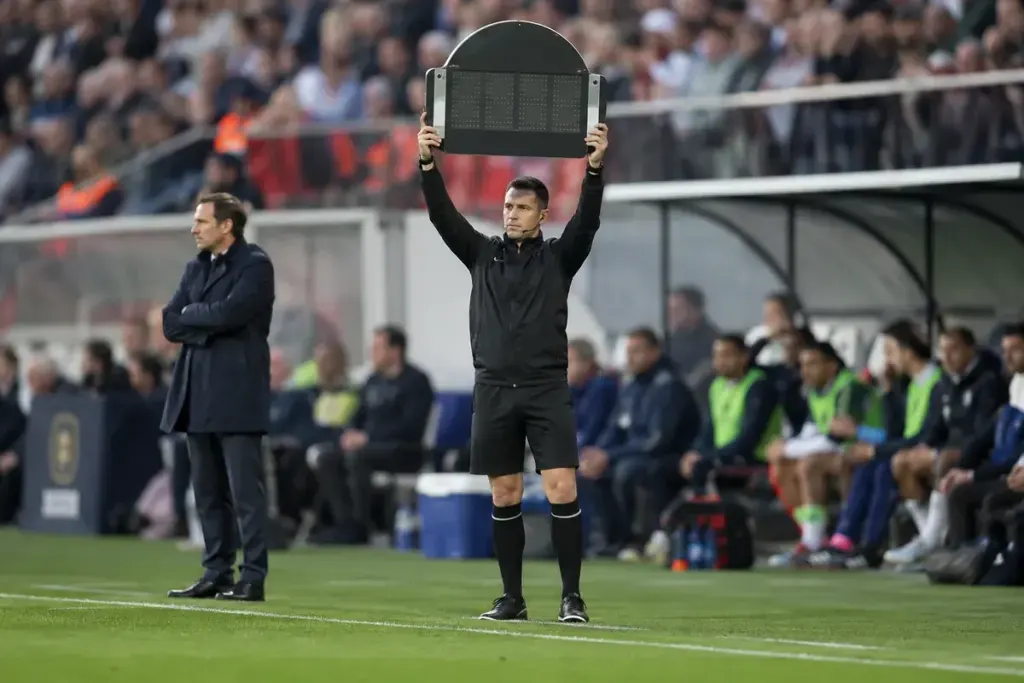
The board shows four minutes, the clock reaches 94:00 and the referee still has not blown the final whistle. That does not by itself establish a timing error. The number indicated is the minimum additional time, rather than a promise that the match will end at that exact display on the broadcast clock.
IFAB Law 7 explains allowance for time lost and the fourth official’s indication of the minimum decided by the referee. The additional time can be increased, but not reduced. Further delays during the added period can therefore affect when play finishes.
Keep a sequence, not just a screenshot
For an invented example, the board indicates four minutes near the end of the second half. A significant interruption then occurs during that period. A still image of the clock beyond 94 minutes does not show the interruption or explain the referee’s allowance. Review what happened after the board was raised before drawing a conclusion.
The law lists several reasons for allowing lost time, including substitutions, injury assessment, disciplinary sanctions and goal celebrations. Spectators generally do not have the referee’s complete timing record. An informal stopwatch can support a question, but it should not be presented as definitive proof of the official calculation.
Also separate additional time from extra time. Additional time belongs at the end of each half to account for time lost. Extra time is a separate competition procedure used in some matches to help determine a winner. A league match reaching the 96th minute has not necessarily entered an “extra-time period” in that technical sense.
When discussing a controversial finish, identify the half, the indicated minimum and the relevant subsequent interruptions. If the evidence does not establish the full sequence, say so. Reading the board as a minimum makes the final minutes easier to follow without assuming that every second beyond the displayed number is unexplained.