
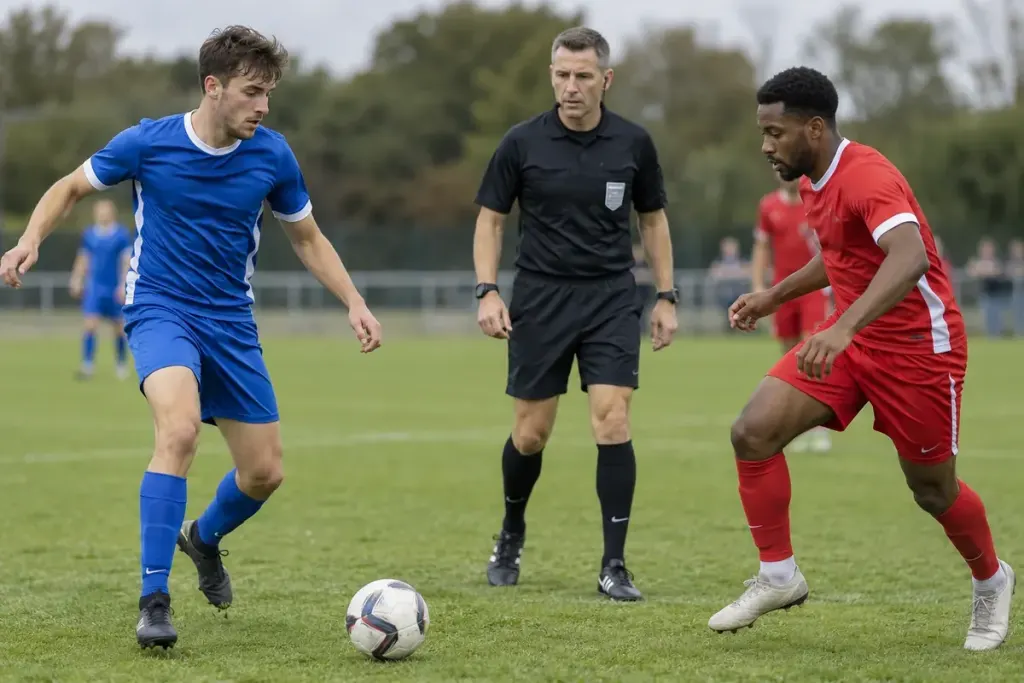
A pass clips the referee and rolls towards another player. Some spectators immediately shout for a dropped ball; others expect play to continue. The contact alone does not answer the question. What happens because of it matters.
Under IFAB Law 9, play stops when the ball touches a match official, remains on the field, and a team starts a promising attack, the ball goes directly into the goal, or possession changes. The restart is a dropped ball. Other contact with an official can leave the ball in play.
Watch the consequence, not only the collision
Imagine a routine pass brushing the referee and continuing to the intended teammate without creating a promising attack. That is different from the same deflection delivering the ball to the opponents. In the second example, the change of possession is one of the specified reasons to stop.
Another useful contrast is a ball redirected straight into the goal. The fact that it crossed the line does not erase the intervening contact and the Law 9 condition. Nor should viewers treat the referee’s touch as a deliberate handball or foul by a player.
When reviewing a clip, include a few seconds before and after the touch. A close-up may prove contact while hiding the position of teammates and the developing attack. A wide view helps explain why a referee judged the outcome differently from what the tight camera angle suggested.
Keep the decision to stop separate from the details of the restart. The applicable edition of Law 8 supplies the dropped-ball procedure, and competition rules can specify which edition applies. For a match note, record the contact, the resulting possession or attack, and the restart separately. That produces a clearer account than simply writing “the ball hit the referee.”