
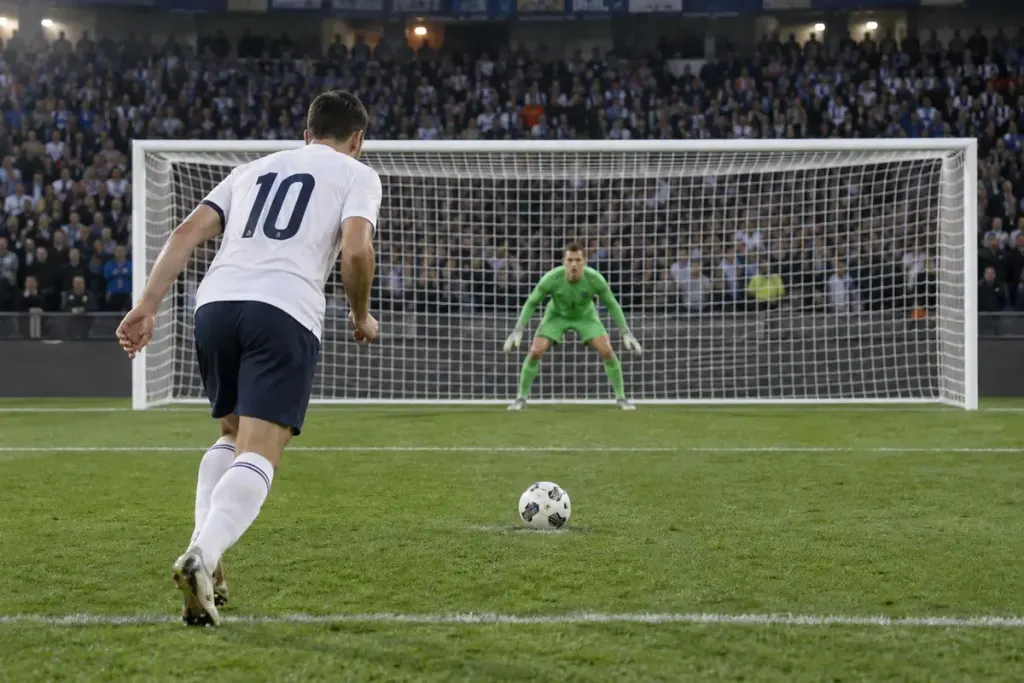
A penalty taker slows, pauses and accelerates again. The goalkeeper moves, the ball enters the net, and the argument begins: was that hesitation allowed? The useful question is where the feint occurred in the sequence, not whether the approach looked unusual.
IFAB Law 14 permits feinting during the run-up. It treats feinting to kick after the run-up has been completed differently. For that illegal feint followed by the kick in ordinary match play, the kicker is cautioned and the defending team receives an indirect free kick, regardless of whether the ball enters the goal.
Watch the approach as a sequence
Begin the replay before the final step. Identify the player’s movement toward the ball, the completion of that approach and the action that follows. A freeze-frame of a raised foot cannot, by itself, explain how the sequence developed.
For an illustrative contrast, imagine one player changing pace halfway to the ball and then taking the kick. Now imagine another completing the approach and pretending to strike before finally kicking. Those descriptions raise different questions under the law, even if both make the goalkeeper react.
Do not apply one restart to every situation
A penalty shoot-out has its own outcome provisions. There is also a distinction when the player never kicks the ball and it never comes into play. IFAB’s examples address these cases; they should not be squeezed into the ordinary match-play example above.
Other infringements can happen at the same time. Rather than deciding that any simultaneous encroachment automatically produces a retake, read the law’s treatment of combined offences and the relevant incident.
When discussing a decision, describe the action you can actually see: “The pause appears to be during the approach,” or “The player seems to have completed the run-up before the fake kick.” That is more useful than calling every stop illegal, and it leaves room for a better camera angle to change the assessment.