
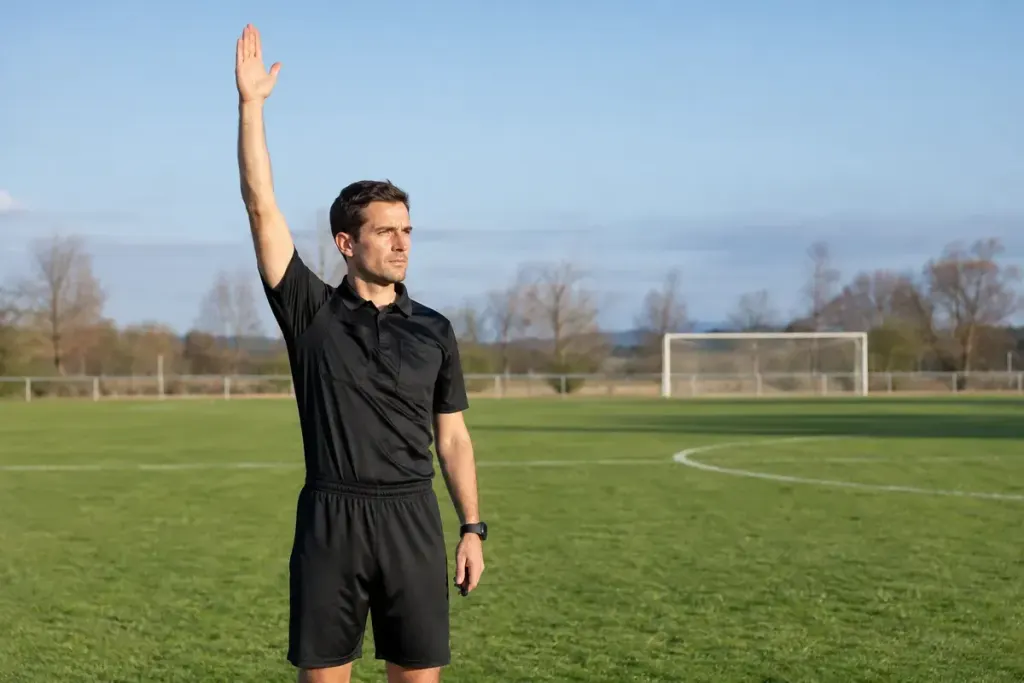
The referee points to the restart, then keeps one arm raised. Players arrange themselves as if a shot might follow, but that raised arm tells you something important: the free kick is indirect.
Under IFAB Law 13, an indirect free kick requires the ball to touch another player before a goal can be scored. The referee raises an arm to signal it and keeps the signal until the relevant condition in the law is met. The signal is more informative than the distance from goal.
Watch the first two contacts
In a simple invented sequence, one attacker nudges the stationary ball and a teammate shoots. The second player’s touch is what changes the direct-goal question. A tiny movement is not enough merely because it looks intentional: the ball must be kicked and clearly move to be in play.
If an indirect free kick goes straight into the opponents’ goal without another player’s touch, the restart is a goal kick. If it goes directly into the kicker’s own goal, the opponents receive a corner. Those outcomes differ from the ordinary excitement of seeing the ball cross a goal line.
Do not identify the offence from the signal alone
Several situations can produce an indirect free kick. The arm tells you the restart type, not the complete explanation of the preceding decision. Look at the referee’s communication, the incident and the applicable law before announcing why it was awarded.
For a viewing exercise, pause a replay before the kick. Note the raised arm, the ball’s first movement and the next player to touch it. Then replay at normal speed. This focuses attention on the sequence rather than on whether the final shot looked impressive.
Keep the rulebook attached to the competition
Local formats can have authorised variations, and referees manage unusual incidents using the full laws. If a dispute concerns a real match, check the current competition rules and official explanation. For a spectator, the simplest useful habit is to look up at the referee before looking toward the goal.