
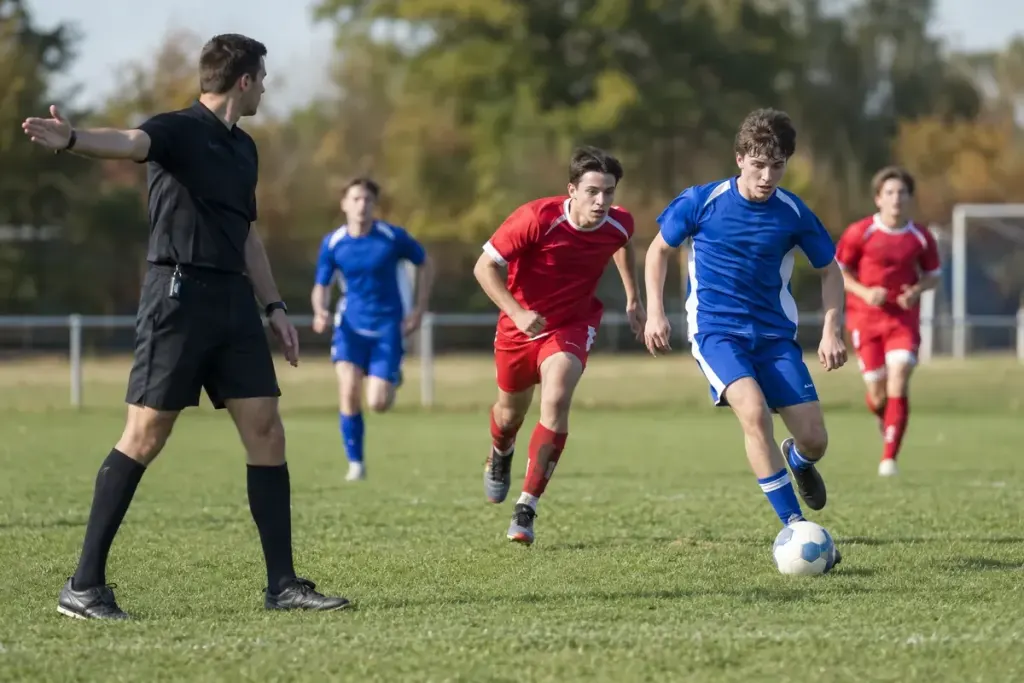
An attacker is fouled, the ball moves to a teammate and the attack continues. In another sequence, the whistle sounds and a player immediately passes the stationary ball to restart. Both can look fast, but they are different situations.
Ask whether play stopped
Under IFAB Law 5, the referee can allow play to continue when the non-offending team benefits from advantage. If the anticipated advantage does not develop at that time or within a few seconds, the referee can penalise the original offence.
A quick free kick follows a stoppage. The restart still has to meet the applicable requirements in Law 13. Speed does not make a restart the same thing as advantage, and it does not remove the referee’s control of the situation.
Watch a complete sequence
Use a replay that includes the challenge and the next few seconds. Listen for the whistle, watch the referee’s signal and note whether the ball remained in play. A short highlight starting after the challenge may hide the detail that distinguishes the two cases.
In an illustrative sequence, a player is tripped but a teammate immediately controls the ball with a useful attacking opportunity. Continuing may benefit that team. In a second example, the referee stops play and the team restarts from the required place. The similar forward pass does not mean the same decision occurred.
Do not judge advantage only by the final score
An attack ending without a goal does not by itself show that advantage was wrong. The question is the benefit available when play continued, not whether every later action succeeded. Disciplinary action and serious offences also have specific rules beyond this introductory distinction.
Next time commentary says “they played it quickly,” identify which event actually happened. Was there an uninterrupted attack, or a legal restart after a stoppage? That small observation makes the referee’s role easier to follow.