
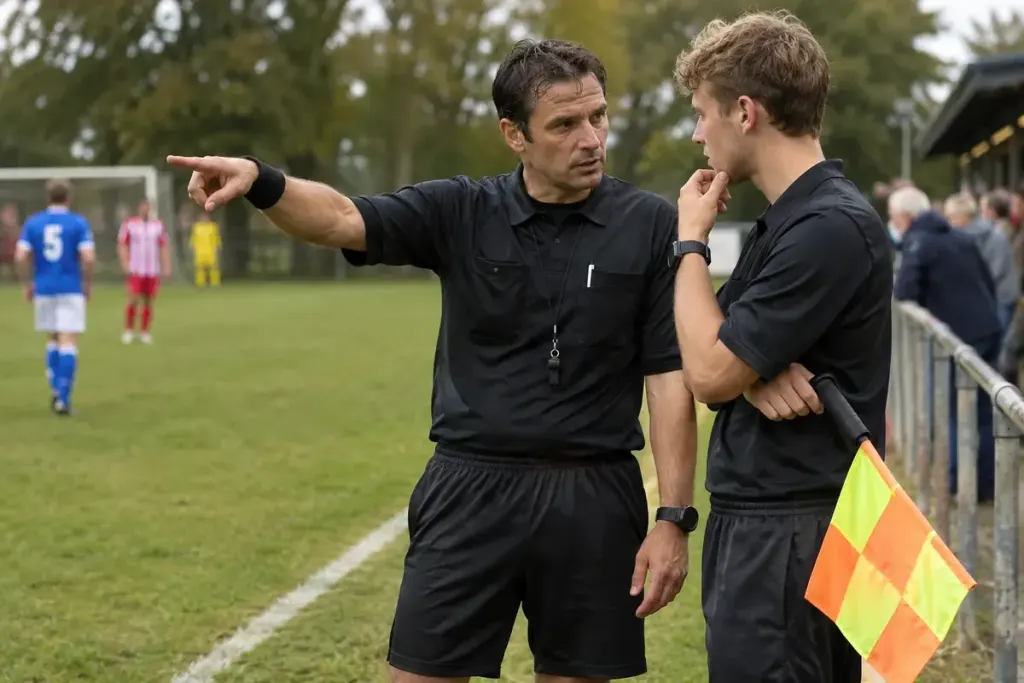
A substitute steps over the touchline before a goal goes in. Television shows the extra person, and the immediate argument is that the goal must be cancelled. The actual decision needs more information than a head count.
IFAB Law 3, The Players distinguishes the identity of the extra person, their interference with play, and whether the referee discovers the situation before or after the restart. Those details explain why two superficially similar clips can produce different decisions.
Ask who interfered
If, before restarting, the referee finds that an extra player, substitute, substituted or sent-off player, or team official belonging to the scoring team was on the field and interfered with play, the goal must be disallowed. The law specifies a direct free kick from the extra person’s position.
Interference is the crucial qualification. A picture showing a substitute just inside the boundary is not, by itself, a complete explanation of what happened. Look at the sequence rather than relying on a still image.
The treatment of an extra person associated with the conceding team differs: the law provides for allowing the goal. An outside agent, such as a spectator, falls into another category, with an exception concerning a ball going into the goal. Do not borrow the rule for a substitute and apply it indiscriminately to every pitch invasion.
Put the incident on a timeline
Imagine reviewing a disputed goal with three notes on a page: entry onto the field, the action affecting play, and the restart. These are an observation aid, not a substitute for the referee’s judgement.
- Identify the person rather than assuming a tracksuit means substitute.
- Describe the action: touching the ball, challenging a player, or merely standing nearby are different observations.
- Establish whether the referee discovered the extra person’s presence before play restarted.
Law 3 says the goal cannot be disallowed for this reason once play has restarted. The referee still has responsibilities concerning the extra person and reporting the incident. When discussing a clip, separating the goal decision from later disciplinary or administrative action makes the conversation much clearer.