You checked the Premier League fixture list months ago.
Your club was playing on Saturday afternoon.
Perfect.
You planned the weekend around it.
Maybe you booked a train.
Maybe you arranged a hotel.
Maybe you simply told everyone:
“Don’t make plans for Saturday. I’m watching the match.”
Then you check again.
The match is now on Sunday.
Or Friday night.
Or Monday evening.
Sometimes even the kick-off time has changed while the opponent remains exactly the same.
So what happened?
The short answer is that the Premier League fixture list released before a season is not necessarily the final schedule for every match.
Understanding why Premier League fixtures change requires understanding how many competitions, broadcasters, clubs and scheduling restrictions are interacting throughout a football season.
And in 2026/27, that puzzle is particularly complicated.
The First Fixture List Is Not the Final Version
When the Premier League publishes the season schedule, all 380 league matches receive an initial place in the calendar.
For 2026/27, the league campaign began on Friday, 21 August 2026 and is scheduled to finish on Sunday, 30 May 2027.
The season contains 33 weekends and five midweek match rounds.
But there is one phrase supporters should remember:
fixtures are subject to change.
The Premier League itself makes this clear when publishing the schedule.
Why Are So Many Games Initially Listed at 3 PM?
When an initial fixture schedule is published, many weekend games appear in the traditional Saturday 15:00 UK slot.
That does not necessarily mean they will ultimately be played then.
The initial schedule provides the basic framework.
Broadcast selections and other scheduling considerations can subsequently move matches into different slots.
Think of Fixture Release Day as the Skeleton of the Season
You learn:
who plays whom,
the intended match round,
home and away order,
and the broad position of the game in the calendar.
But some precise dates and times remain capable of changing.
Television Is One of the Biggest Reasons
The Premier League is watched globally.
In the UK, live television selections can move matches away from their original slots.
For the current cycle, Sky Sports and TNT Sports hold UK live broadcast rights, and broadcast selections are a major reason fixtures are rescheduled.
That Is Why You See Different Kick-Off Slots
Instead of every game happening simultaneously on Saturday afternoon, Premier League weekends can include matches on:
Friday evening,
Saturday lunchtime,
Saturday evening,
Sunday,
and Monday evening.
Exact slots vary by matchweek.
A Match Being Moved Does Not Mean Something Went Wrong
Often it simply means the game has been selected for television.
But Television Is Only Part of the Story
This is where fixture scheduling becomes more complicated.
Premier League clubs also compete in other competitions.
That creates conflicts.
European Football Can Move Premier League Games
In 2026/27, nine Premier League clubs are participating in UEFA competitions.
That matters enormously.
A club cannot simply play European football and then be assigned another match without sufficient consideration for recovery and competition scheduling.
Champions League Scheduling Can Affect Domestic Slots
The Champions League is primarily played during the middle of the week.
If a club has a particular European commitment, the Premier League may need to consider which domestic slots remain workable around it.
Europa League and Conference League Can Have an Even More Visible Weekend Effect
These competitions commonly include Thursday matches.
A club playing on Thursday cannot reasonably be expected to play a Premier League match immediately afterward on Saturday.
The Premier League specifically notes this scheduling issue when explaining fixture changes.
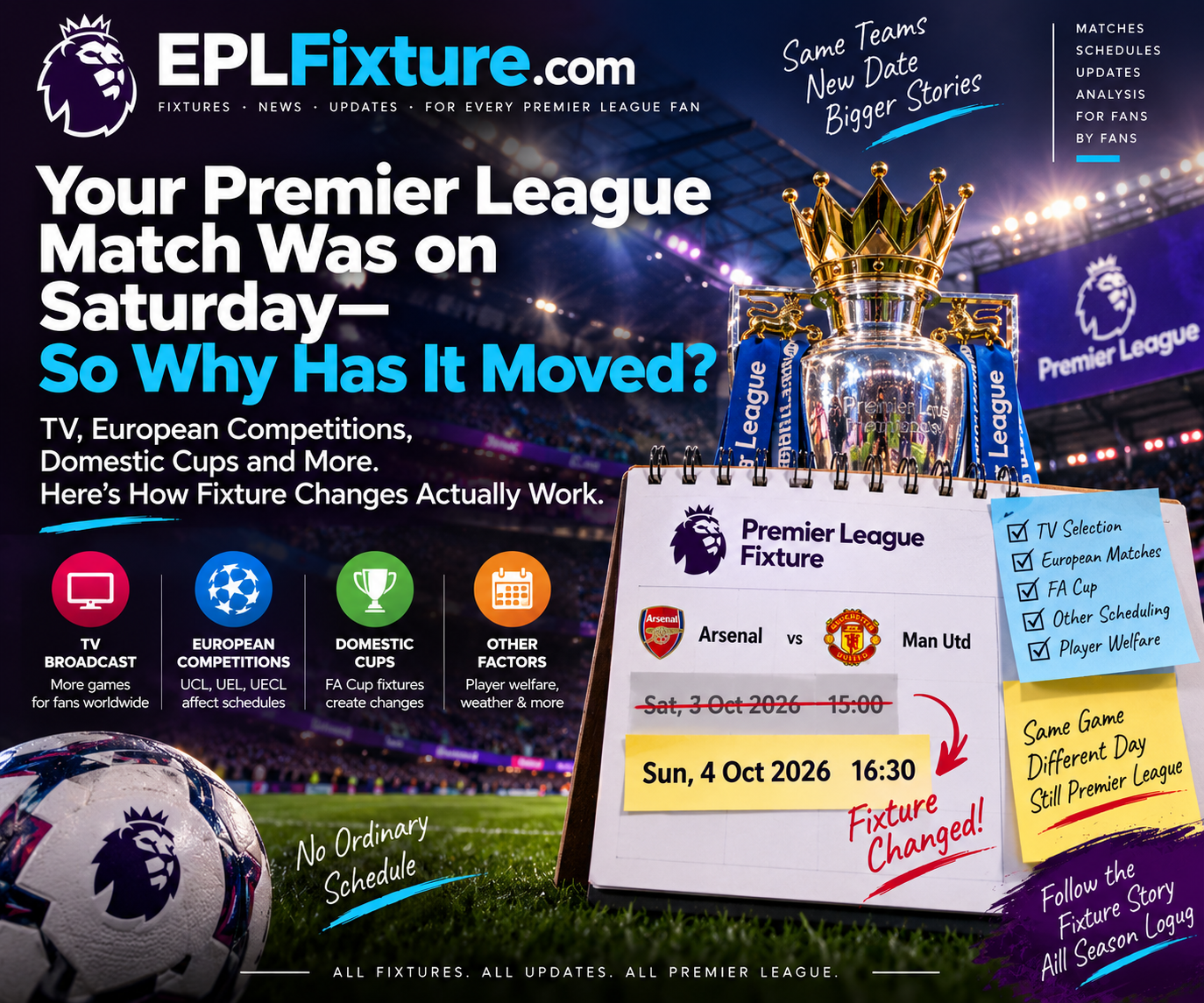
So Saturday Can Become Sunday
This is one of the classic changes supporters see.
Originally:
Saturday, 3 PM
Later:
Sunday afternoon
The opponent has not changed.
The matchweek has not necessarily changed.
But another competition has altered the practical scheduling options.
We Have Already Seen This in 2026/27
For example, Premier League amendments announced on 1 September included matches being moved because of clubs’ UEFA competition schedules.
Leeds United v Crystal Palace was moved to Sunday, 20 September because of Palace’s Europa League fixture, while other matches were also adjusted around European commitments.
That is a perfect real-world example of why fans should not treat an early fixture date as permanently fixed.
The FA Cup Can Create More Changes
Domestic cup football creates another layer.
The FA Cup operates alongside the Premier League.
As clubs progress deeper into the competition, clashes can occur.
Cup Progress Is Impossible to Fully Predict Months Ahead
When the league schedule is first created, nobody knows exactly which clubs will reach:
later rounds,
semi-finals,
or finals.
This Creates Conditional Fixtures
You may occasionally see a Premier League fixture accompanied by wording such as:
“subject to participation in…”
That means the fixture could move depending on what happens in another competition.
Football Scheduling Is Full of Dependencies
Team A progresses.
Match B moves.
That affects available broadcast slots.
Another fixture may then need adjustment.
One Result Can Affect a Future Calendar
This is why late-season scheduling can sometimes remain uncertain longer than supporters would prefer.
Why Can’t the Premier League Confirm Everything Before the Season Starts?
Because too many future events are unknown.
Imagine trying to finalize every match time in June.
You do not yet know:
which clubs will progress in every cup,
which European competition dates will affect specific clubs,
which matches broadcasters will prioritize later,
or which fixtures may need rearranging because of unforeseen circumstances.
A Full Football Season Is Dynamic
The calendar has to respond to events.
Broadcasting Selections Are Announced in Stages
The Premier League publishes approximate windows for when television-related fixture amendments are expected to be announced.
For 2026/27, these announcements are spread throughout the season rather than every match being finalized on Fixture Release Day.
This Is Important If You Are Traveling to a Match
Suppose you see:
Saturday, 7 November — 15:00
If the relevant broadcast selections have not yet been finalized, do not automatically assume that date and time are guaranteed.
Check the Fixture’s Confirmation Status Before Making Expensive Plans
Especially for:
non-refundable flights,
hotels,
long-distance trains,
or international travel.
Fans Traveling From Abroad Need to Be Particularly Careful
Premier League tourism is enormous.
Supporters fly to England expecting to see a specific match.
A Saturday-to-Sunday change might be manageable.
A Saturday-to-Monday change can completely destroy a short weekend itinerary.
Build Flexibility Into Your Trip
If football is the primary purpose of the trip, avoid designing a schedule that works only if the fixture remains in one exact slot.
Staying an Extra Night Can Sometimes Protect the Trip
It costs more, but it can reduce the risk created by fixture changes.
Always Check the Latest Official Schedule
Do not rely on a screenshot saved months ago.
Old Fixture Graphics Become Outdated
A social-media graphic from Fixture Release Day may still circulate after a match has moved.
Search Results Can Also Lag Behind
Different websites update at different speeds.
For critical travel planning, verify against current official club or Premier League information.
Why Do Some Games Move to Monday?
Monday-night football is part of the broadcast schedule.
A match may be selected for that slot depending on broadcasting and competition considerations.
But European Commitments Can Limit Monday Options Too
If a club has an upcoming European match early in the following week, Monday may not be practical.
Every Slot Has Consequences
Moving one match is not as simple as dragging an event around a calendar.
You have to consider what each club is doing:
before the match,
after the match,
and sometimes several days later.
Why Do Some Matches Move to Friday?
Friday-night fixtures can also form part of the Premier League broadcast schedule.
Again, club commitments around the match matter.
A Friday Match Changes the Previous Week Too
A team cannot simply be moved earlier without considering when it played its previous game.
Rest Periods Matter
The schedule has to consider appropriate gaps between matches.
The Christmas Period Is Especially Complicated
English football is famous for its festive schedule.
Matches continue around Christmas and New Year.
But player welfare and recovery have become increasingly important parts of calendar design.
For 2026/27, the Premier League says no two match rounds over Christmas and New Year will take place within 60 hours of one another.
That Does Not Mean Every Club Gets a Long Holiday
It means the match-round structure is being designed with minimum spacing commitments in mind.
Boxing Day Remains Part of the Football Calendar
The 2026/27 schedule includes a fuller Premier League programme around Boxing Day than the previous campaign.
Midweek Match Rounds Work Differently
The 2026/27 season contains five midweek match rounds.
These are built into the league calendar.
Midweek Fixtures Are Not Necessarily “Postponed Games”
This distinction matters.
A scheduled midweek round was always intended to be played during the week.
A rearranged match is a game that moved from its previous position.
Fans Often Call Both “Midweek Games”
But they have different scheduling histories.
What Happens When a Match Is Postponed?
A postponed fixture has to find a new place in the calendar.
That sounds simple.
It often is not.
Both Clubs Must Be Available
Suppose Team A has a free Wednesday.
Great.
But Team B may have:
a European fixture,
a domestic cup match,
or another rearranged game.
The Available Calendar Shrinks Quickly
Especially for successful clubs competing in multiple competitions.
The Later the Season Gets, the Harder It Can Become
Progress in cup competitions creates more commitments.
This Is Why “Just Play It Next Wednesday” Is Not Always Possible
That Wednesday may already belong to another competition.
Weather Can Still Affect Fixtures
Severe weather can occasionally cause postponements.
But the issue is not simply whether the pitch itself is playable.
Supporter Safety Can Matter Too
Conditions around:
roads,
public transport,
stadium approaches,
and local infrastructure
can affect whether staging a match safely is practical.
Decision-Making Depends on the Circumstances
There is no universal rule that snow automatically cancels football.
Modern Premier League Pitches Are Sophisticated
But supporters still have to reach the stadium.
Other Exceptional Circumstances Can Also Cause Changes
Football does not operate independently of the real world.
Fixtures can occasionally be affected by:
major public events,
security considerations,
transport issues,
or other exceptional circumstances.
These Are Less Predictable Than Broadcast Changes
Which is why no fixture calendar can be absolutely guaranteed months in advance.
Why Are Some Matches Played at the Same Time?
Most Premier League fixtures are spread across multiple television slots.
But there is one famous exception:
the final day.
For 2026/27, the final match round is scheduled for Sunday, 30 May 2027, with all fixtures kicking off simultaneously.
Why Simultaneous Kick-Offs?
Competitive integrity.
If teams competing for:
the title,
European qualification,
or survival
played at different times, one team could know exactly what result it needed based on an earlier match.
Playing Together Reduces That Advantage
Everyone begins with the same information.
Final-Day Football Is Therefore Different
Ten matches.
Twenty teams.
One synchronized start.
What About the Opening Weekend?
The 2026/27 season provides a good example of how a matchweek can already be distributed across several days.
The campaign opened on Friday, 21 August with defending champions Arsenal hosting promoted Coventry City.
The rest of Matchweek 1 was spread across Saturday, Sunday and Monday.
One Matchweek Does Not Mean One Day
This is fundamental to understanding EPL fixtures.
A matchweek is a group of league fixtures.
It does not necessarily correspond to a single Saturday.
What Does “Gameweek” Mean?
Fans—especially Fantasy Premier League players—often use Gameweek.
The Premier League itself also uses Matchweek terminology in scheduling contexts.
Usually the Concept Is Similar
A numbered group of league fixtures.
But postponed and rearranged matches can make things more complicated in fantasy football.
Double Gameweeks Can Appear
If a previously postponed fixture is rearranged into a week where a team already has another Premier League match, that club may play twice within the fantasy gameweek.
Blank Gameweeks Can Also Happen
A club may have no league fixture within a particular fantasy gameweek because its scheduled match was moved.
This Is Why Fixture Changes Matter to FPL Players
The calendar becomes strategy.
Fixture Difficulty Is Another Layer
Fantasy managers often examine sequences of opponents rather than isolated games.
The Premier League publishes Fixture Difficulty Ratings to help FPL managers assess upcoming schedules.
But Difficulty Is Not the Same as Certainty
A favorable run of opponents can still be disrupted by:
European commitments,
fixture rearrangements,
or changing dates.
Check Both Opponent and Schedule
Not just the color on an FPL difficulty chart.
Why Do Broadcasters Want Different Time Slots?
Because spreading matches allows more games to be shown live individually.
If five major matches all kick off simultaneously, viewers can watch only one in full.
Separate Slots Create Separate Broadcast Windows
That benefits broadcasters and viewers who want to watch multiple matches.
But There Is a Trade-Off
What works well for television does not always work well for match-going supporters.
Monday Night Can Be Difficult for Away Fans
Especially when traveling long distances.
Late Sunday games can also create transport challenges.
This Tension Is Part of Modern Football Scheduling
Television is central to the Premier League’s global reach.
Match-going supporters still need practical schedules.
Both realities exist at the same time.
Why Does My Fixture App Show a Different Time?
First check the time zone.
A Premier League match listed at:
15:00 UK time
will appear at a different local time in:
Singapore,
New York,
Sydney,
Jakarta,
Tokyo,
or elsewhere.
This Sounds Obvious Until Daylight Saving Changes
The UK’s clock changes during the season.
That can alter the time difference between Britain and countries that:
do not change clocks,
change on different dates,
or use different daylight-saving rules.
Do Not Memorize One Time Conversion for the Entire Season
The offset may change.
Let a Reliable Calendar Handle Time Zones
Digital calendars can automatically convert fixture times to your device’s local zone.
The Premier League offers a digital fixture calendar for this purpose.
Calendar Sync Is Better Than Screenshots
A screenshot freezes information.
A synchronized calendar can reflect updates.
That Is Exactly What You Want for Fixtures
Because fixtures move.
How Far Ahead Are TV Fixtures Confirmed?
There is no single number covering the entire season.
The Premier League publishes estimated announcement periods for different blocks of matchweeks.
For example, the 2026/27 schedule provides separate announcement windows for October, November, December/January, February, March, April and May selections.
Late-Season Confirmation Can Be More Difficult
Why?
Because cup progress is increasingly relevant.
By spring, organizers need to know which teams remain in:
European competitions,
the FA Cup,
and other scheduling-sensitive situations.
The Calendar Becomes More Conditional
That can reduce how early certain matches are finalized.
A Fixture Can Even Move More Than Once
This is another reason screenshots are dangerous.
A game might first move for television.
Then another competition creates a conflict.
Further adjustment becomes necessary.
Always Treat the Latest Confirmed Information as the Relevant Version
Not the first version you saw.
Real Example: October and November 2026
Broadcast amendments for Matchweeks 6–9 were announced in August.
They included matches distributed across Saturday, Sunday and Monday slots, such as Liverpool v Manchester City on Sunday and Coventry City v Newcastle United on Monday.
That Is Normal Premier League Scheduling
Not an exception.
How Should Fans Read a Fixture List?
Instead of seeing:
Saturday 3 PM
and thinking:
“Confirmed forever.”
Think:
Current scheduled slot—check whether broadcast arrangements are finalized.
Three Levels of Confidence Are Useful
Broad matchweek: relatively useful for early planning.
Specific day: verify before booking.
Exact kick-off: verify again close to travel.
This Habit Prevents Expensive Mistakes
Especially for international supporters.
Before Booking Travel, Check Four Things
First, verify the fixture on an official source.
Second, check whether the relevant broadcast selections have been announced.
Third, look at the club’s European or cup commitments around that date.
Fourth, use flexible travel arrangements where practical.
Never Base an Expensive Trip on a Search-Engine Snippet Alone
Schedules change faster than some pages update.
What If You Already Bought a Match Ticket?
Ticket policies vary by club and circumstances.
A fixture moving does not automatically mean your ticket becomes invalid.
But travel arrangements are a separate issue.
Check Directly With the Club
Especially if:
the match date changes,
you cannot attend,
or you have hospitality arrangements.
Do Not Assume Another Club’s Policy Applies to Yours
Each club can have different ticketing procedures.
Why Premier League Fixture Tracking Is Useful
A fixture page should not merely answer:
“Who plays this weekend?”
It should also help fans understand:
what has changed,
what is confirmed,
what may still move,
and why.
Context Makes a Schedule More Useful
A date without status can be misleading.
EPLFixture.com Should Treat Fixture Status as Part of the Data
For future site structure, useful labels could include:
Confirmed
Subject to Change
Rescheduled
Postponed
TV Selected
This Helps Readers Understand What They Are Looking At
Especially when planning ahead.
2026/27 Premier League Calendar at a Glance
The season began on 21 August 2026.
The final round is scheduled for 30 May 2027.
There are 380 Premier League fixtures.
The season uses 33 weekends and five midweek rounds.
And Many Individual Kick-Off Details Can Change
That is not a flaw in the fixture list.
It is a consequence of fitting the Premier League into a much larger football calendar.
Nine English Clubs in Europe Makes Scheduling Even More Complex
The Premier League has specifically warned supporters about the knock-on scheduling effects created by nine clubs participating in UEFA competition during 2026/27.
More Competitions Mean More Dependencies
And more dependencies mean more potential changes.
The Best Rule for Supporters Is Simple
Never assume an early fixture time is permanent.
Check again.
Especially before spending money.
FAQ
Why do Premier League fixtures change?
Fixtures can move because of television selections, UEFA competition schedules, domestic cup commitments, postponements and other scheduling requirements. The Premier League therefore publishes fixtures as subject to change.
Why do Premier League games move from Saturday to Sunday?
Television selection can cause a move, while European commitments can also require different weekend scheduling. Clubs playing in Thursday UEFA competitions, for example, cannot simply play again on the following Saturday.
Are Premier League fixture dates final when they are released?
No. The initial fixture list establishes the season schedule, but individual dates and kick-off times can subsequently change.
When does the 2026/27 Premier League season end?
The final match round is scheduled for Sunday, 30 May 2027, with matches kicking off simultaneously.
How many Premier League matches are there in 2026/27?
There are 380 matches across the 20 Premier League clubs.
Why are all Premier League games played together on the final day?
Simultaneous final-day kick-offs help protect competitive integrity because teams competing for the title, European qualification or survival play without knowing the final result of another relevant match beforehand.
Can European football change Premier League fixtures?
Yes. Champions League, Europa League and Conference League schedules can affect when domestic matches can be played. Nine Premier League clubs are involved in UEFA competitions in 2026/27.
Can a Premier League fixture move more than once?
Yes. Further scheduling conflicts can occasionally require additional amendments after an earlier change.
Should I book flights as soon as Premier League fixtures are released?
Be careful with non-refundable arrangements. Verify whether the fixture has been confirmed for broadcast and consider that European or cup commitments may still affect scheduling.
How can I keep track of Premier League fixture changes?
Use current official Premier League and club information rather than relying on old screenshots. The Premier League also provides a digital calendar designed to sync fixtures to devices.
Conclusion
The Premier League fixture list looks simple.
Twenty clubs.
Thirty-eight matches each.
Three points for a win.
Put every game on a calendar and start playing.
But behind that calendar is a scheduling puzzle involving:
television,
European football,
domestic cups,
recovery periods,
stadiums,
supporters,
travel,
and events that have not happened yet.
That is why Premier League fixtures change.
The match you originally saw listed for Saturday afternoon was not necessarily wrong.
It was the schedule at that point.
Then more information became available.
A broadcaster selected the match.
A club qualified for another competition.
A cup tie created a conflict.
Or another part of the football calendar forced an adjustment.
For supporters, the practical lesson is simple.
Treat fixture release as the beginning of your planning—not the end of your checking.
Save the matchweek.
Follow your club.
Use an updating calendar.
And before booking an expensive train, hotel or international flight, verify the latest confirmed date and kick-off time.
Because in the Premier League, the opponent may stay the same—
while the day you are supposed to meet them can still move.